
-

Cash management, Macro and markets
A new chapter for the renminbi – and what it means for European corporates
What elements is China putting in place to build a complete renminbi financial ecosystem? And what does this mean for European corporates? flow summarises the latest findings from Deutsche Bank Research
MINUTES min read
Over the past decade, China has actively been working to transform the renminbi (RMB) from a trade-heavy currency into a global currency for investment and financing, in a bid to further couple with global markets and internationalise its official currency.
This article analyses the progress to date in these attempts to build out the RMB financial ecosystem and provides insights on what this means for European corporates, leaning on a July 2026 report from Deutsche Bank Research Institute, The Rise of the RMB Financing Ecosystem: From Panda and Dim Sum Bonds to Deeper Capital Markets.
RMB internationalisation ramps up
The report’s authors – Perry Kojodjojo and Chen Kan – note the country’s “policy stance on RMB internationalisation has shifted from cautious to explicit, with the 15th Five-Year Plan (2026-30) elevating it to a strategic priority” amid a wider context of global de-dollarisation. (For more on de-dollarisation see the April 2026 Deutsche Bank Research report, The Return of History: Gold, the Dollar, and the Monetary Future).
Regulatory initiatives continue to accelerate RMB internationalisation, including the establishment of an RMB Repo Facility for Foreign and International Monetary Authorities, announced by The People’s Bank of China (PBoC) in June 2026 at the annual Lujiazui Forum in Shanghai.1 This will allow foreign central banks and other official institutions to access RMB liquidity, with the aim of fostering international investment in yuan assets.
At the same time the PBoC also unveiled a pilot programme that will allow selected state-owned banks to conduct offshore RMB activities directly within Shanghai's Free Trade Zone. Central bank Governor Pan Gongsheng outlined plans to reinforce Shanghai’s role as an offshore yuan hub by further developing its offshore financial services sector and bond market.
This increase in regulatory momentum coincides with a changing picture for cross-border RMB usage.
Cross-border usage – a fundamental change
The Deutsche Bank Research analysts outline that a “fundamental change” has occurred when it comes to the nature of cross-border RMB usage: “The centre of gravity has moved from trade to investment flows, with capital and financial account transactions now constituting around 75% of total RMB settlements.”
Although trade settlement remains strong – see Figure 1 – RMB transaction volumes via China’s Cross-Border Interbank Payment System (CIPS) have hit a record high in 2026 (see Figure 2), while the onshore Panda and offshore Dim Sum bond markets are seeing strong growth and entering “a new, more dynamic chapter”.
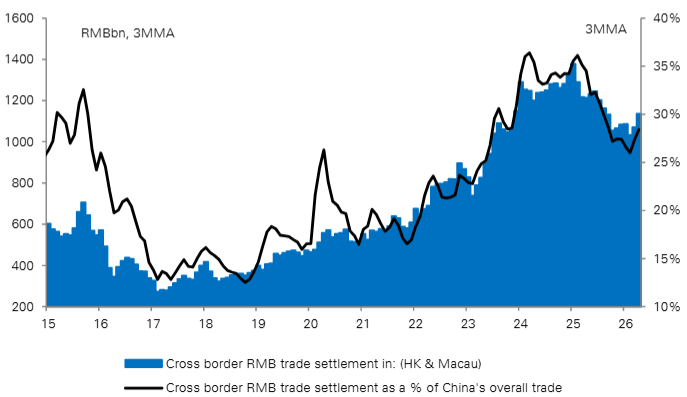
Figure 1: A more active use of RMB in trade settlement
Source: Deutsche Bank Research, Bloomberg Finance LP, CEIC, Haver, Wind
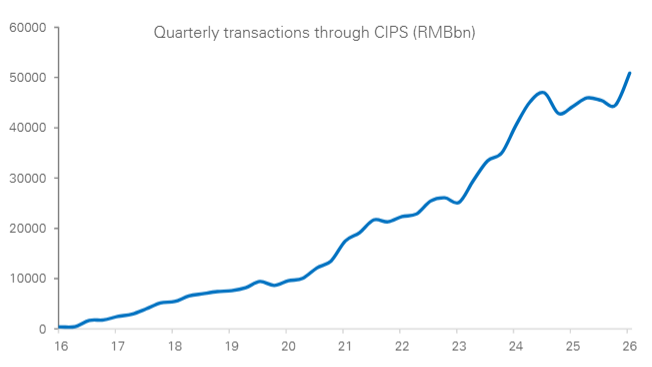
Figure 2: RMB transactions through CIPS hit a record high
Source: Deutsche Bank Research, Bloomberg Finance LP, CEIC, Haver, Wind
Kojodjojo and Kan point out, however, that there is work to do if China is to fully realise its RMB internationalisation ambitions, with the currency holding “only a 1–4% share across global payments, FX reserves, and debt securities, which is disproportionately low compared to China’s approximately 19% share of global GDP”.
Indeed, the “next phase of internationalisation requires building a deeper and more accessible financial ecosystem for raising and deploying RMB capital globally”, and the analysts identify the Panda and Dim Sum bond markets as key to achieving this, alongside “more sophisticated hedging tools and a broader array of attractive RMB-dominated assets”.
Bond markets key to RMB’s international expansion
The report notes that Panda and Dim Sum bonds “are set to be the two core pillars driving the RMB’s evolution from a trade-settlement currency into a global investment and financing currency”, creating an ecosystem for offshore players to fund, invest and manage RMB holdings.
Panda bonds – renminbi-denominated debt issued by foreign entities within China – have recently “matured into a strategic funding tool for foreign issuers”. This shift is confirmed by the fact the market is experiencing a record year, with issuance in the first half of 2026 surpassing RMB160bn.
“The next phase of internationalisation requires building a deeper and more accessible financial ecosystem for raising and deploying RMB capital globally”
Kojodjojo and Kan highlight that foreign issuers “are now a cornerstone of the market”, accounting for over 30% of issuance, while early signs of diversification beyond financial institutions (FIs) are encouraging (see the below section on European corporates’ RMB participation). The cutting of regulatory red tape around fund usage has been a “game-changer”.
The offshore Dim Sum market, which sees CNH bonds issued in Hong Kong, is experiencing something of a sea change, with “a surge in sophistication and diversity signalling its evolution from a policy-driven market into a mature offshore funding hub”. This is thanks, in part, to new issuers including tech firms – particularly IT companies – and the availability of longer-term bonds.
As with Panda bonds, foreign entities form an important segment of the issuer base, accounting for over 25% of issuance. The report authors expect that new regulations, including allowing mainland insurers to invest in the market via the so-called Southbound Bond Connect2, will “unlock a massive and sustainable new pool of capital”, providing a “significant boost” to the market.
One of the core challenges in both bond markets – broadening the issuer base beyond FIs – can be overcome if a complete RMB financing ecosystem is built, “supported by deep secondary-market liquidity, reliable benchmark yield curves for price discovery, and comprehensive risk-management tools”.
The analysts believe this is “a gradual but foundational journey to establish the RMB as a more widely funded, invested, and held international currency”, and the Panda and Dim Sum bond markets are positioned as integral components of this international expansion.
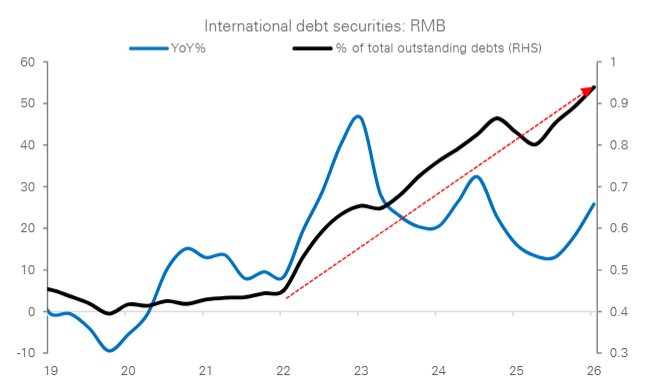
Figure 3: RMB-denominated debt issuance has risen notably
Source: Deutsche Bank Research, Bloomberg Finance LP, CEIC, Haver, Wind
European corporates’ RMB participation
The report reveals that while European entities are responsible for the bulk of foreign issuance in Panda and Dim Sum markets (half of Panda and a third of Dim Sum issuance), corporates are conspicuous by their absence, with participation restricted to a handful of repeat FI borrowers, who account for over 90% of activity with an 85–95% estimated market share.
Corporates have, to date, struggled to overcome hurdles including an unfamiliar market, smaller deal sizes and a narrower investor base. However, the analysts expect to see a pick-up in European corporate issuance as RMB internationalisation progresses, and tailwinds could be provided by the possibility of deepening EU-China relations.
Dialogue is underway over a long-standing trade deficit between the bloc and China, which totalled €360 billion in 2025 (the EU exported €199.6 billion worth of goods to China and imported €559.4 billion)3. Brussels and Beijing are currently participating in formal consultations that will encompass export controls and trade and investment balancing, as the bloc seeks to address the deficit.4
Kojodjojo and Kan anticipate that barriers to European corporates will dissolve in light of a deeper offshore RMB ecosystem that “will support larger benchmark issuance, broaden the investor base and improve liquidity”. When paired with factors including low China interest rates and growing China-related business exposure – particularly if the outcome of trade consultations proves favourable – the RMB funding appeal for corporates could be enhanced.
The analysts “expect future market development to be driven by a broader range of international issuers, particularly European corporates, rather than larger issuances from existing borrowers”, as the cost-benefit equation improves.
Banks have a key role to play in enhancing China-Europe financial connectivity. Deutsche Bank’s appointment by the PBoC to serve as a RMB clearing bank for Europe in Frankfurt, announced on 10 August 2026, is intended to help strengthen RMB clearing infrastructure and provide access to reliable offshore RMB liquidity for FIs and corporates in Europe.
As the first foreign bank to receive this designation in Europe, Deutsche Bank will facilitate direct end-to-end processing, clearing and settlement services for cross-border RMB transactions for European FIs and businesses, acting as a local bridge to China’s payment systems. Leo Yin, President of Deutsche Bank (China) Co., Ltd., noted: “By connecting onshore and offshore RMB ecosystems and expanding RMB use cases across Europe and key trade corridors, we aim to help clients capture new opportunities arising from the evolving RMB landscape.”
“As global businesses navigate an increasingly complex and uncertain environment, they are seeking greater flexibility, resilience and choice in managing international financial flows,” said Gerald Podobnik, Co-Head of Deutsche Bank Corporate Bank. “The RMB clearing capability in Frankfurt will further enhance our ability to support clients as they integrate RMB into their global operations and take advantage of the opportunities created by the continued evolution of the RMB internationalisation.”
Deutsche Bank Research reports referenced
The rise of the RMB Financing Ecosystem: From Panda and Dim Sum Bonds to Deeper Capital Markets by Perry Kojodjojo and Chen Kan (16 July 2026)
The Return of History: Gold, the Dollar, and the Monetary Future by Mallika Sachdeva and Michael Hsueh, (27 April 2026)
Sources
1 See China makes new push to take yuan global, vows vigilance against financial risks | Reuters at reuters.com
2 See Stock Connect Explained at hkex.com
3 See Trade in goods with China in 2025 - News articles - Eurostat at ec.europa.eu
4 See EU and China Agree on October Deadline to Reset Trade Ties - Bloomberg at bloomberg.com


You might be interested in

Cash Management, Opinion
New ways to manage liquidity in APAC New ways to manage liquidity in APAC
Dealing with trapped cash is becoming increasingly important for corporate treasurers in these turbulent times. In India and Korea, they can now benefit from regulatory easing, reports Deutsche Bank’s Christof Hofmann

flow case studies, Cash management
Henkel China: a Shanghai powerhouse Henkel China: a Shanghai powerhouse
The sealants-to-shampoos multinational is steadily expanding its products portfolio in Asia Pacific and digitalisation of payments is sharpening its customer service. Henkel China’s Regional Treasurer APAC, Sophie Yang, tells flow’s Will Monroe that innovation is central to driving growth
Trade finance, Macro and markets
China’s huge trade surplus – where next? China’s huge trade surplus – where next?
Drawing on a Deutsche Bank Research report examining China’s exports and their destinations, flow’s Clarissa Dann reports on how trade geopolitics are rerouting the country’s trade corridors and what this means for the Global South building its own export capabilities and workforces