
-
Trust and securities services, Macro and markets
Europe’s T+1: towards 90% global alignment
When the EU, UK and Switzerland move from T+2 to T+1 settlement in October 2027, most of the world’s major markets will be aligned on a one-day settlement cycle. Reporting from Sibos Miami 2026, flow’s Clarissa Dann explores why a successful transition will depend on the collective efforts of the entire post-trade ecosystem
MINUTES min read
At Sibos Miami 2026, Swift set out a vision of “a new frontier of trust, speed and transformation”, one in which the financial community comes together to tackle the shared challenge of moving money faster.
That message resonates strongly in the securities services industry, where markets around the world are navigating the shift towards globally aligned T+1 settlement (trade date plus one).
While the topic of T+1 settlement has featured in several preceding Sibos events, it was the immediacy of Europe’s pending transition to T+1 that brought an intensity to panel and client discussions in Miami.
Shorter settlement cycles are, as the US Depository Trust and Clearing Corporation puts it, driving the need for robust post-trade automation “to enable faster post-trade processing, ensure compliance, and strengthen operational resilience in an increasingly connected marketplace.”1 However, getting the world’s market infrastructure participants to align on a joined-up move has been easier said than done.
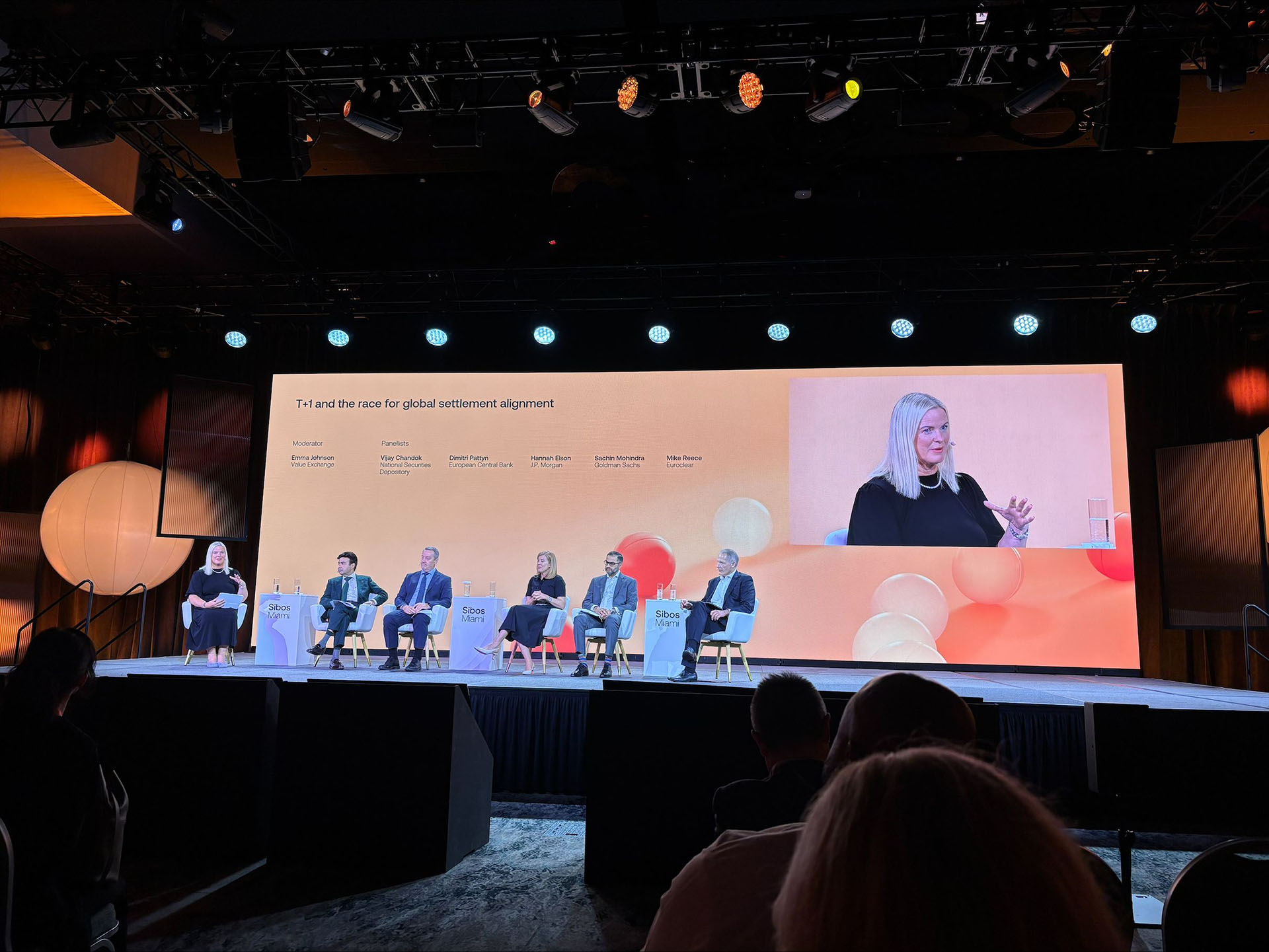
“Today roughly three quarters of the world’s equity market capitalisation – so some US$114trn – already settles on a T+1 basis or faster. That includes the US, Canada, and India – with China already running on a T+0 cycle,” said Emma Johnson, Head of Industry Advocacy & Insight at The ValueExchange, as she moderated the panel ‘T+1 and the race for global settlement alignment’.
In less than a year, 30 markets across the EU, UK and Switzerland will move to T+1 settlement, increasing that share of global market capitalisation from 75% to around 90%. While on paper this looks like a global alignment, Johnson cautions that “when you get under the bonnet it’s far from it.”
Based on insights from two Sibos panels, this article examines the progress made and remaining hurdles as Europe enters the final stretch of its T+1 transition.
Fragmented but mobilising
The EU T+1 Industry Committee’s second market-wide Readiness Survey, conducted by the ValueExchange and published in July 2026,2 indicated accelerated preparations for the October 2027 transition with “strong engagement” from the industry, but identified “clear gaps in vendor guidance, fund share-dealing readiness and operational dependences”.3 The complexity of the alignment across different countries and market infrastructure segments is underlined in the survey’s summary of response sources. See Figure 1.
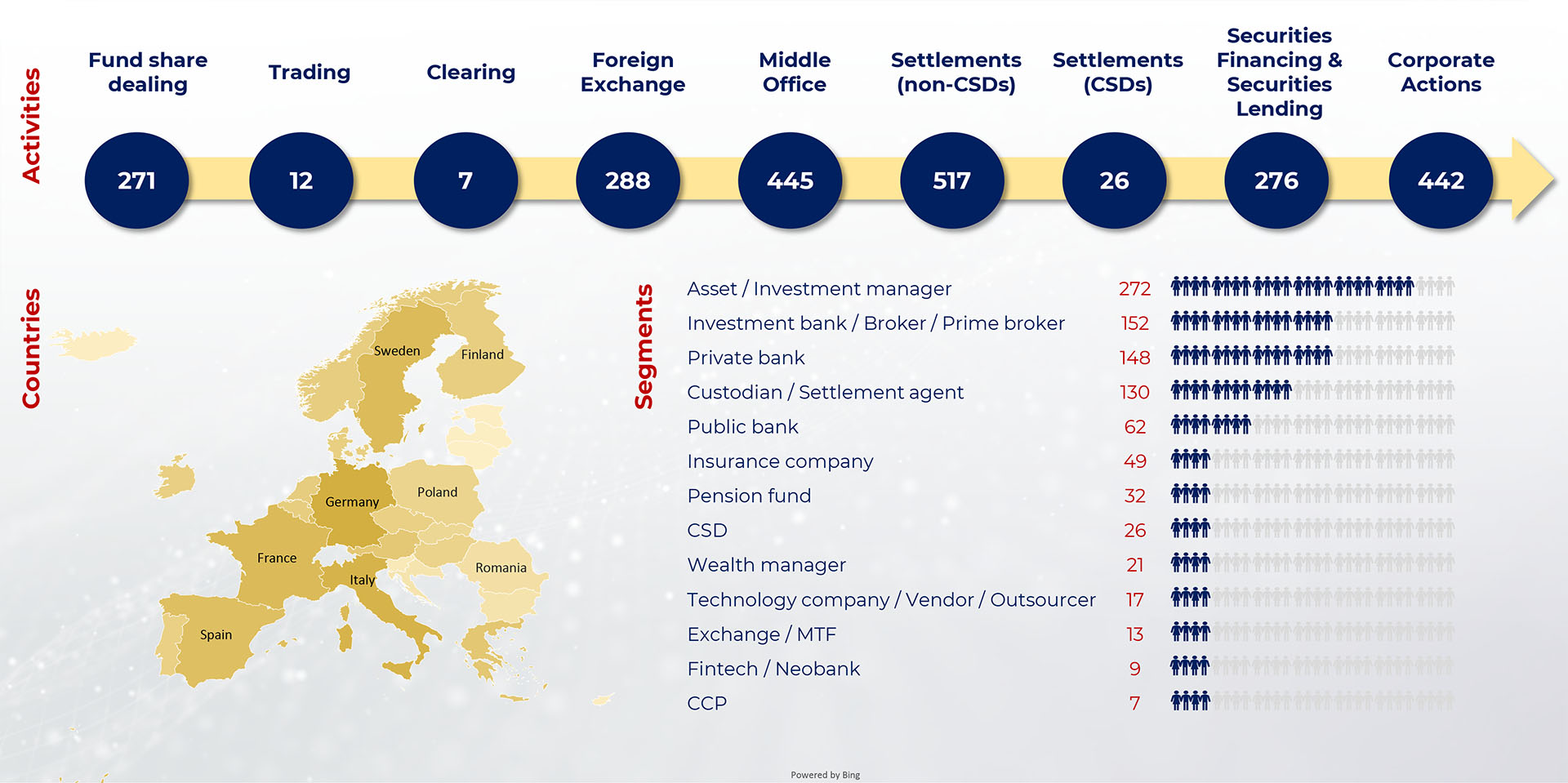
Source: EU T+1 Industry Committee Readiness Survey (Q2 2026), The ValueExchange
Hannah Elson, Global Head of Custody at J.P. Morgan, sees the EU+ journey as “fragmented but mobilising”. The difference between this migration and those that preceded it (such as India and North America) is “the sheer number of market infrastructures, currencies, and regulators we are trying to align around one single day and point in time”. Euroclear’s Head of Market Liquidity, Mike Reece, added that while the actual direction of travel was aligned, “the operational reality remains fragmented and as markets accelerate at different paces we are going to have to continue living with that friction”.
Panellists agreed that inconsistent regulatory requirements in the region were “worrying”. The last time the bloc pulled together on a comparable regulatory requirement was the implementation of the Central Securities Depositories Regulation’s (CSDR) Settlement Discipline Regime. Introduced on 1 February 2022, the regime brought in a suite of measures aimed at reducing settlement fails and improving settlement efficiency across European markets.
Elson said one of the learning points from SDR was the disruption caused by a lack of regulatory harmonisation across jurisdictions, which resulted in chaos for those first few weeks in terms of reporting and data and standards. This translated into a lot of operational risk. With market participants now operating in an environment of settlement penalties, the impact of any disruption could be amplified unless it is effectively mitigated. As a result, readiness cannot be confined to market infrastructures alone; all participants across the settlement chain must be fully tested, prepared and aligned before the move to T+1.
An example of the impact when readiness is uneven across communities is the controlled extension of Standards Release 2026, which was announced by Swift shortly before Sibos.4 This postponed the move from unstructured to structured postal addresses for ISO 20022 payment processes, which was originally scheduled for November 2026 (see the flow article ‘Building on today’s payment foundations’). The securities element is being decoupled from the broader release and will go live in June 2027, given the T+1 migration target in October of that year. See Figure 2.
The industry must now absorb two distinct Swift releases in a single calendar year. The June 2027 release is critical. It represents the final messaging baseline before Europe adopts T+1 in October 2027. Several readiness milestones depend on SR2026 changes, and it now adds pressure to the project agenda for firms in 2027 as they prepare for the T+1 transition.
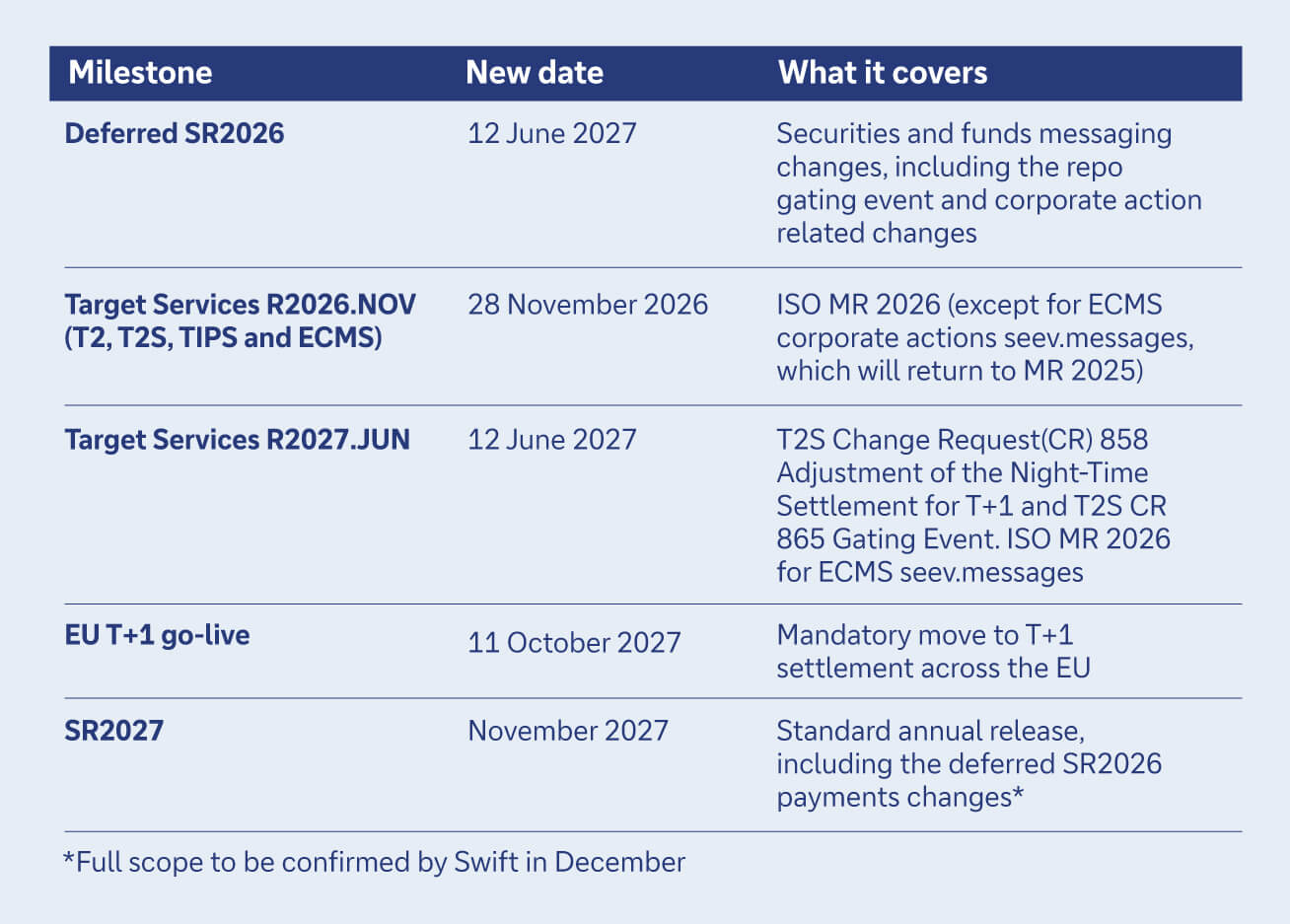
Source: Swift, Deutsche Bank
Working together
Dimitri Pattyn, Deputy Director General for Market Infrastructure and Payments at the European Central Bank (ECB), agreed that the move to T+1 in Europe is more complex than that of other jurisdictions. He noted that a successful T+1 needs the reach of stakeholders and coverage in terms of processes. This was why the European Securities and Markets Authority, the ECB and the European Commission established a governance structure with the EU T+1 Coordination and EU T+1 Industry Committees. The EU T+1 Industry Committee launched a roadmap in July 2025.5 This body has been fundamental to coordinating the EU’s go-live preparations.
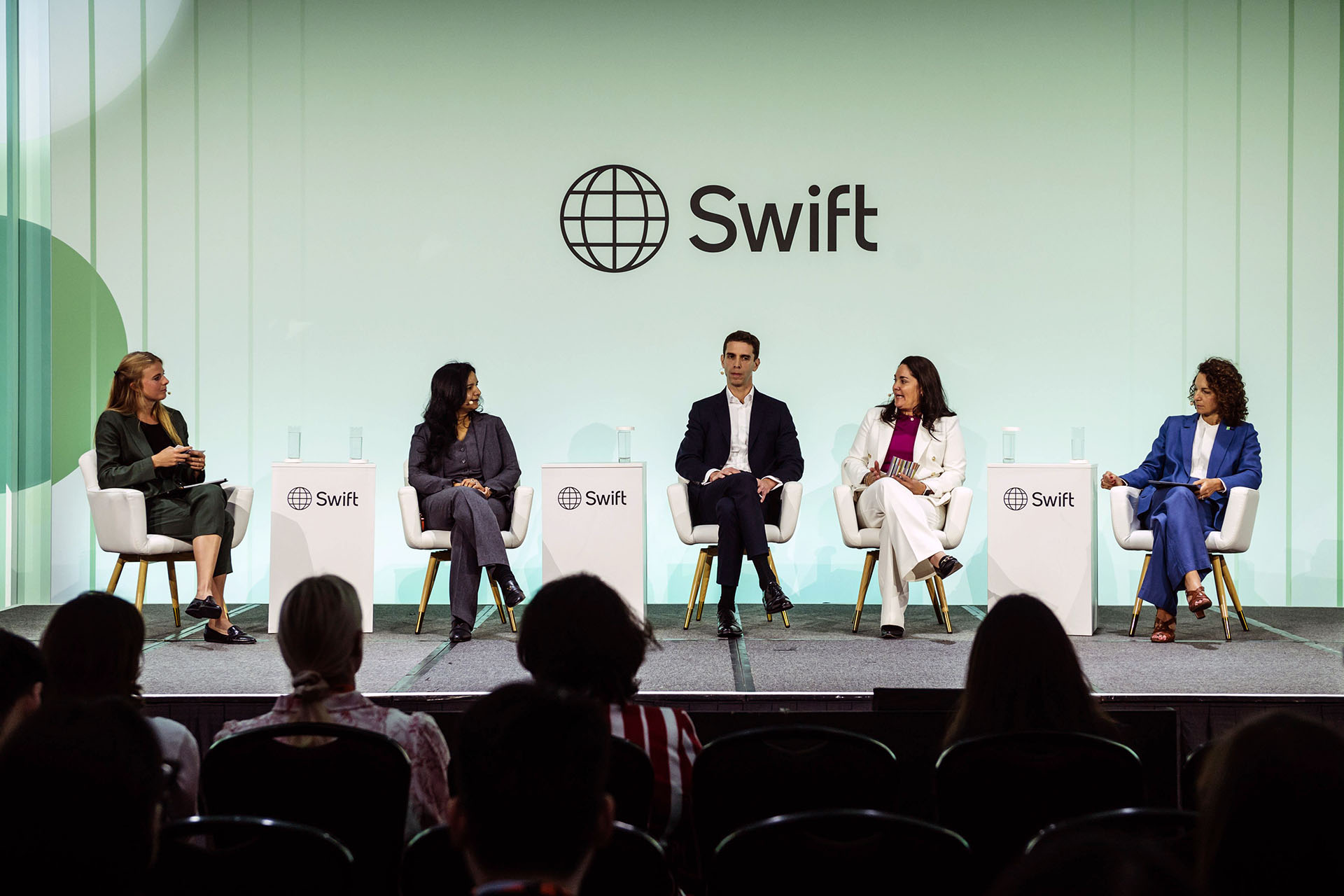
‘Making T+1 a reality: standards, data and collaboration’: Left to right: Jennie Baisch, Director, Global Securities Strategy, Swift; Ruchi Saraswat, Head of Technology Funding & Payments, Royal Bank of Canada; Daniel Clark, Global Head of Depositary Receipts, Head of Trust & Securities, APAC and MEA Deutsche Bank; Laura Cote, Senior Vice President, U.S. Bank; and Camille Papillard, Deputy Head of Financial Intermediaries & Corporates Client Line for Securities Services, BNP Paribas
The points about collaboration within the industry, alignment and testing were developed further in the ‘Making T+1 a reality’ panel. “T+1 is mostly about collaboration from different angles,” commented Camille Papillard of BNP Paribas.
Firstly, this must be within organisations because “you need to make sure that internally you have the systems that interconnect and teams that talk to each other much more than they used to,” she continued. Papillard’s point was that before there were 12–14 hours to manage a settlement, but with T+1 this is reduced to 3–4 hours. The batch approach with separate teams no longer works.
Secondly – as illustrated in the Readiness Survey (see Figure 1) – collaboration must be across the whole value chain. She highlighted that 64% of respondents had said that “counterparty, intermediary and tech provider dependency” were their biggest hurdles to success. She continued, “You need to know how your broker, your custodian and the central securities depositories (CSDs) are going to behave and adapt when working on your own readiness.” Furthermore, given the number of CSDs (Europe’s network comprises more than 30 national and international CSDs) it will be “very challenging” to manage testing if each CSD has their own testing plan.
Learning points from live T+1 markets
Although North America’s migration to T+1 in 2023 was much simpler than the current European journey, it was agreed there are some useful learning points. Laura Cote from U.S. Bank said that while collaboration was key to the outcome in the US, education and automation also “really enable success”. In her opinion these two factors will be key to success in Europe “because of the number of players in the mix”.
Ruchi Saraswat of the Royal Bank of Canda reflected on the need for “collaboration across counterparties” in addition to automation and strengthened tech infrastructure, given there are “so many areas which require each one of them to step in and have a human intervention”.
Asset managers want their allocations much earlier and while straight through processing (STP) without manual intervention made this possible in 2023, for 2027 there needs to be further compression. Pre-trade settlement instructions need to be available earlier. Across the transaction lifecycle, she said, “there is no room for errors or delays, and it all has to be automated; there cannot be any gaps in communication”. In her view, despite the successful North America migration, there were too many exceptions in the system requiring manual intervention. “Rather than just having a protocol to align and manage our exceptions, we need to start building a centralised system,” she argued.
Turning to Asia, Deutsche Bank’s Daniel Clark emphasised the importance of collaboration between regulators, market infrastructures, CSDs and industry participants, noting the value of constructive industry engagement during consultation periods to help shape practical and resilient market frameworks.
The bank’s white paper, ‘Asia T+1: speed without fragility’ (September 2026) sets out a potential toolkit for consideration as markets across the region assess the transition to T+1. It recognises the complexities of Asia’s diverse market landscape, including multiple time zones and currencies, varying levels of market maturity, market fragmentation and distinct regulatory frameworks.
China Northbound Connect, continued Clark, “has been in operation for more than 10 years and was designed around a highly controlled pre-trade framework, with securities settlement effectively operating on T+0 and cash settlement on T+1”. This model requires investors to confirm securities availability before entering a sell trade, reflecting the market’s specific settlement structure and controls.
“India, by comparison, adopted a different transition approach by moving to T+1 in January 2023, implementing the change through a phased migration across different market segments. This required market participants to manage both T+2 and T+1 processes during the transition, highlighting the operational considerations involved in a market-wide settlement cycle change.”
Enriching the data
“Data is critical and enriching the data is equally important,” Clark concluded, noting this was particularly evident during India’s transition. “The adoption of foundational data standards has helped improve transparency across the transaction lifecycle. From our perspective stronger and more consistent data supports more effective tracking, facilitates investigation and repair processes, and can help reduce settlement exceptions by enabling participants to identify issues across the value chain.”
J.P. Morgan’s Elson had made a similar point in the other ‘Race for global settlement alignment’ panel, explaining that the data provided “a much greater level of visibility and transparency around where trades are in the lifecycle, what the causes of failures are, and what the interconnectivity is between all the different points”. This helps her operations teams and clients “understand the efficiencies and inefficiencies in their flows”.
By the time the Sibos community reconvenes next year there will be just days to go until the T+1 transition in Europe. The discussions at Sibos 2027 in Singapore therefore look set to take on a rather different tone...
Sibos Miami took place from 28 September to 1 October 2026. Clarissa Dann is a freelance financial journalist and former Editorial Director, Marketing at Deutsche Bank
Images: Courtesy of Swift
Sources
1 See T+1 in Asia-Pacific: Preparing Post-Trade Operations for What’s Ahead at dtcc.com
2 See EU T+1 Industry Committee Readiness Survey (Q2 2026) at eu-t1.eu
3 See EU T+1 industry committee readiness survey: Q2 2026 key findings at thevx.io
4 See Swift accepts community request to extend structured address migration for ISO 20022 payment messages at swift.com
5 See High-level roadmap to T+1 securities settlement in the EU at eu-t1.eu


You might be interested in

Trust and Securities Services
Europe’s T+1 transition: lessons, readiness and what firms need now Europe’s T+1 transition: lessons, readiness and what firms need now
With Europe’s October 2027 T+1 transition deadline now firmly in scope – and its practical complexities crystallising – flow securities services correspondent Janet du Chenne meets the Deutsche Bank Trust and Securities Services team translating US lessons, internal readiness work and industry guidance into coordinated client action

flow white papers and guides
Asia T+1: speed without fragility Asia T+1: speed without fragility
As Asia's markets assess accelerated settlement, this white paper explores how the region can move to T+1 while maintaining liquidity, resilience and cross-border investability. It examines the operational, funding and market-structure challenges of compressed timelines and the capabilities needed for a successful transition

Trust and securities services
Custody in an age of fragmentation Custody in an age of fragmentation
How are global custodians navigating the fragmented geopolitical landscape? And what’s their take on digital assets and artificial intelligence? flow shares insights from BBH, Clearstream, JP Morgan and State Street
Custody in an age of fragmentation More