
-
Trust and securities services, Technology
From investment to asset servicing: AI’s growing influence
Artificial intelligence (AI) creates investment opportunities across Asia and changing post-trade operations. Investors and asset servicers face distinct questions: where will value emerge, and where can AI improve operations?
MINUTES min read
AI investment is supporting economic activity and trade despite geopolitical tensions, inflationary pressures and market volatility. In its October 2026 World Economic Outlook, the International Monetary Fund (IMF) projected global growth of 3.1% this year, identifying the AI investment boom as a major contributor.1
At the same time, financial institutions are exploring how AI can address longstanding operational challenges in asset servicing. These two dimensions of AI’s growing influence formed the focus of The Asset’s ninth Future of Asset Servicing Leadership Series, hosted in association with Deutsche Bank.
AI as an investment opportunity: Asia’s changing value chain
According to the IMF, emerging Asia is expected to grow by 5.1% in 2026 and 4.9% in 2027, with the wider Asia-Pacific region accounting for an estimated 68% of global growth. While Asia has played a central role in driving global growth for several decades, the factors underpinning that growth are changing.2
Lisa Lim, Head of Asia Equities at Rathbones Asset Management, outlined how decades of investment in technology and skills has strengthened Asia’s competitive position. The emergence of global innovation leaders in areas such as AI, green-technology and healthcare in Asia challenged perceptions of US technological dominance, and illustrates this shift.3 “Now we can go to Asia and buy global innovation leaders. In the past, we tended to buy derivatives of global leaders,” she explained.
“Now we can go to Asia and buy global innovation leaders”
For investors however, identifying the winners is complex. This challenge is compounded by the concentration of emerging-market equities in technology-heavy markets such as Taiwan and South Korea, which together accounted for just over 50% of the MSCI Emerging Markets Index as of September 2026.4 Yet not all companies supplying AI infrastructure will benefit equally.
Alex Khosla, Portfolio Manager at BNY Investments Newton, distinguished between parts of the AI hardware supply chain. “There are pieces of that stack where, in our view, earnings streams might be more resilient and underappreciated. And there are pieces of that stack where the reverse is true,” he explained.
Khosla also identified opportunities further along the value chain, among companies developing hardware for practical AI applications. He cited Taiwanese industrial computing specialist Advantech, whose technology is used in applications, and advances in AI are expanding its potential market.
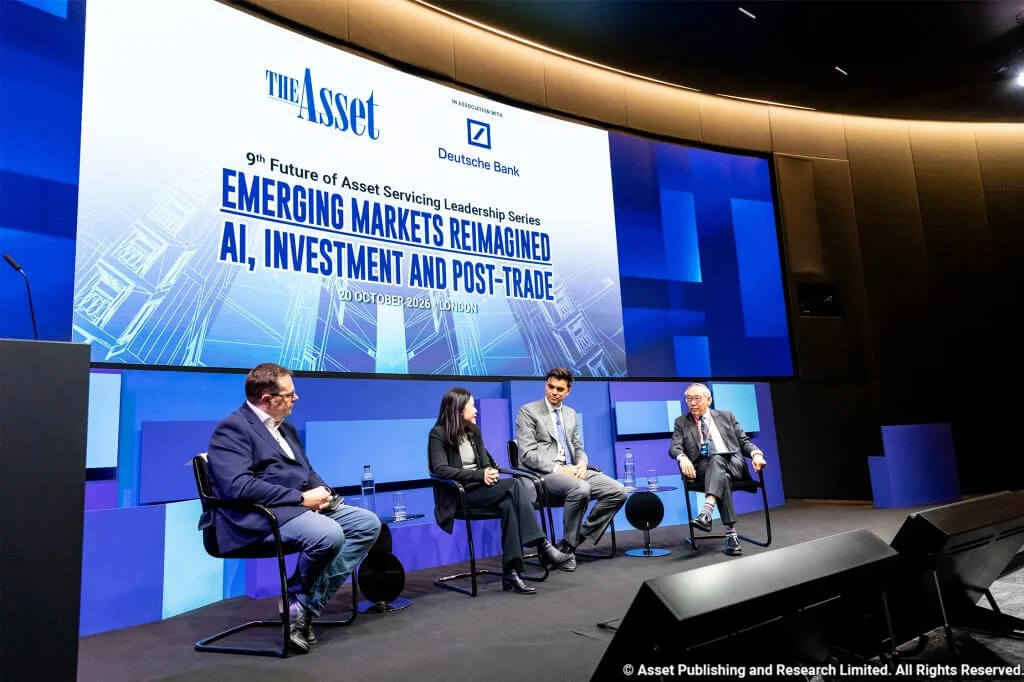
Panel one – ‘Emerging markets, Asia and the future of investing’, from left to right: Robert Gilhooly (Aberdeen), Lisa Lim (Rathbones Asset Management), Alex Khosla (BNY Investments Newton), and Daniel Yu (The Asset, moderator)
Lim urged investors to look beyond AI spending. In Vietnam, for example, growing consumption, supply-chain shifts and rising middle-class wealth offer other opportunities. “Today, the market is very skewed towards short-term AI capex numbers,” she said. “In five to 10 years, I would expect to see a lot of broadening and opportunities for investors across all the countries in emerging markets.”
Where can AI add value in post-trade?
For asset servicers, the question is not which AI companies to buy, but where AI can improve operations. The strongest near-term opportunities lie in processes that still depend on human intervention and unstructured data, the second panel agreed.
While Sam Cauvain-Welsh, Head of Core Product for Global Custody at J.P. Morgan, sees productivity gains in responding to queries and processing physical documents for tax or account opening, Anand Rengarajan, Head of Securities Services Sales at Deutsche Bank, pointed to asset servicing: “That’s where we’re still dealing with a lot of unstructured data and where I think large language models can play a meaningful role.”
In clearing and settlement, however, the opportunity for AI is “somewhat limited because processes are already highly data-driven, structured and automated,” he observed.
“In clearing and settlement, the opportunity for AI is somewhat limited because processes are already highly data-driven, structured and automated”
Corporate actions illustrate one dynamic where AI can improve manual processes. Institutions must interpret issuer announcements, regulatory filings and prospectuses, which are often provided in inconsistent formats. SIFMA and EY research published in 2023 estimated that 46% of global corporate action event data was still published and received manually.5
That’s where AI can help: “In our funds business, we have a large operations team that reads prospectuses and gathers the relevant information”, explained Kate Lowe, Deputy Chief Business Officer at Euroclear UK & International and Head of Data Product at Euroclear. “We’ve used AI to extract that data and are seeing a 97% accuracy rate, which is impressive when you still have a human in the loop,” she reported.
However, when it comes to agentic AI, i.e. an agent processing a series of workflows independently within a mandate, she was much more cautious: “We don’t really see that opportunity yet.”
The distinction between AI’s practical applications today and the prospect of more autonomous operations in the future is explored in greater detail in flow’s special report, ‘Five questions on AI in custody, clearing and fund services’.
Collaboration or competition
Realising AI’s full potential across post-trade will also require institutions to determine where greater industry collaboration is needed – and where opportunities for competitive differentiation remain.
In 2025, Swift, Euroclear, DTCC and 21 other institutions and market infrastructures demonstrated AI extracting and validating corporate action announcements, then converting them into standardised ISO 20022 messages.6
For Lowe, such collaboration reflects the important role market infrastructures can play in establishing common standards and terminology: “Having a shared language becomes even more important with AI, particularly large language models, which are so context driven. If different participants use different contexts, we risk fragmenting the market.”
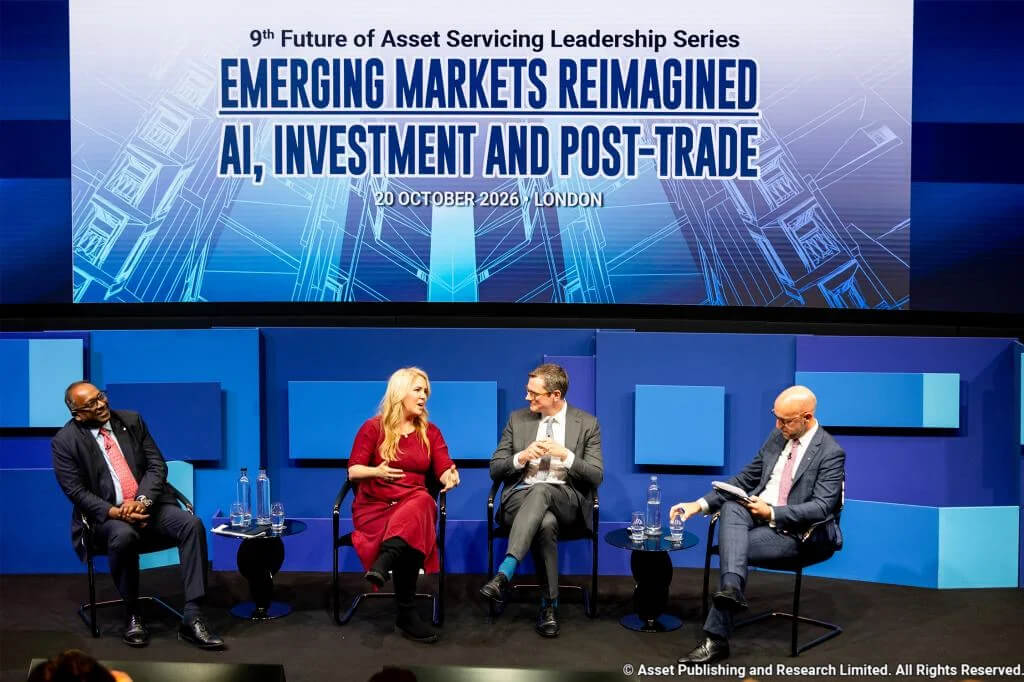
Panel two – ‘AI and the future of post-trade’, from left to right: Anand Rengarajan (Deutsche Bank), Kate Lowe (Euroclear), Sam Cauvain-Welsh (J.P. Morgan) and Nicholas Bone (Deutsche Bank, moderator).
Cauvain-Welsh supported collaboration on controls, human oversight and data segregation, while arguing that firms’ use of AI to deliver client value would remain competitive. “It will be interesting to see how much institutions are willing to share about what they've learned and how they’ve improved their processes. Some of that knowledge they may want to keep to themselves.”
Deployment also depends on overcoming fragmented data and legacy technology. Lowe pointed to decades of technical debt, including spreadsheets, macros and back-end databases. “Creating good data lineage and storage that's accessible to agents is a lot of work, but it's essential to realise the full potential of AI.”
Beyond these technical challenges, the emergence of agent-to-agent interactions adds questions of identity, authorisation and governance: what can agents access and do across institutional boundaries? Legal, regulatory and commercial restrictions on data sharing remain constraints.
Balancing ambition with pragmatism
Looking towards 2030, panellists anticipated more autonomous agents coordinating securities services. Lowe also saw potential for AI and digital assets to converge, simplifying post-trade processes such as collateral management.
For Rengarajan, however, the commercial case remains central. While AI is likely to become embedded in day-to-day operations, more ambitious applications must demonstrate tangible benefits relative to their costs. “What value, and at what cost? Who’s going to pay the cost of it?” he asked.
As Lowe acknowledged, enthusiasm for AI must be balanced with a clear understanding of its value. For securities services providers, the test will be whether investments in AI, data and governance can deliver improvements that extend beyond individual tasks to the post-trade operating model itself.
Post-event highlights featuring a selection of the panellists can be viewed on The Asset website.
The 9th Future of Asset Servicing Leadership Series – Emerging markets reimagined: AI, investment and post-trade took place on 20 October 2026 at Deutsche Bank in London.
Sources
1 See Resilience Under Strain, Urgent Choices at imf.org
2 See Regional economic outlook for Asia and Pacific at imf.org
3 See Challenging US dominance: China’s DeepSeek model and the pluralisation of AI development at iss.europa.eu
4 See MSCI EM (Emerging Markets) Index at msci.com
5 See DTCC Advances Pilot to Further Automate Corporate Actions Announcement Process and Deliver New Efficiencies at dtcc.com
6 See ‘Chainlink and 24 Leading Financial Market Participants Advance Industry Initiative To Solve $58 Billion Corporate Actions Problem’ at prnewswire.com


You might be interested in

Trust and securities services, Technology
What does the future of post-trade look like in the age of AI? What does the future of post-trade look like in the age of AI?
What does the future of post-trade look like in the age of artificial intelligence (AI)? This ‘flow special’ deep dive finds out by posing five key questions

Trust and securities services
Securities 2.0 – towards convergence? Securities 2.0 – towards convergence?
A tipping point for the tokenisation of structured products and securities, enabled by issuer and investor services, might finally be upon us predicts Deutsche Bank’s Paul Maley. Speaking to Janet Du Chenne, he makes clear that client voices and market shifts are pushing the industry toward a more unified model

Trust and securities services
Custody in an age of fragmentation Custody in an age of fragmentation
How are global custodians navigating the fragmented geopolitical landscape? And what’s their take on digital assets and artificial intelligence? flow shares insights from BBH, Clearstream, JP Morgan and State Street
Custody in an age of fragmentation More