
-

Trust and securities services
Securities 2.0 – towards convergence?
Are geopolitical risk, cyber security and shorter settlement cycles making it tougher for post-trade to reap the benefits of AI and the convergence of TradFi and DeFi? flow securities services correspondent Janet Du Chenne reports from the Network Forum Annual Meeting in Paris
MINUTES min read
With the 2026 World Cup underway, and France having lost the 2022 final on penalties to Argentina, a football analogy of forwards and defenders working together as The Network Forum (TNF) convened in Paris for its Annual Meeting (8–10 June) seemed appropriate.
Whether France retrieves its 2018 trophy or not remains to be seen, but delegates at TNF agreed that their goals took the form of achieving digital-enabled growth, while protecting infrastructures from geopolitical risks and cyber threats arising from proliferating artificial intelligence (AI). This article draws together the main insights from the event.
Redefining infrastructure resilience
Global risk intelligence and post-trade infrastructure specialist Thomas Murray’s May 2026 survey,1 published on 8 June, warned that the “classic industry understanding of asset safety is being fundamentally reshaped by cyber risk, geopolitical instability, digitalisation, operational resilience challenges, and growing dependencies across post-trade infrastructure”. Thomas Murray’s Executive Chairman Simon Thomas explained: “The next major disruption may not begin with a financial market crisis or war, it may begin in the infrastructure relied upon to safeguard, settle and protect assets.”
Resilience, something that Euroclear CEO Valerie Urbain highlighted in a flow 2025 profile where she talked about how Europe’s legal and regulatory resilience attracts capital into the bloc, was understandably a recurrent theme at TNF. The issue speakers grappled with was how to capture the benefits of new technology such as AI, while at the same time ensuring the engine room is completely watertight in terms of compliance and cyber security.
Philip Brown, CEO of Clearstream Banking SA (part of the Deutsche Börse Group), highlighted how, in light of new cyber risks underscored by emerging AI technologies, post-trade providers must accelerate the patching of legacy systems to bolster cyber defences.
He explained that firms operating with legacy mainframe technology, developed with conventional waterfall methodology (which prioritises mission-critical stability and strict regulatory compliance required for large-scale transaction processing) are hindered from accessing the firm-wide benefits of AI beyond process improvement, when compared to companies that have already embarked on large-scale cloud migration.
Yet, according to an audience poll, 54% of TNF attendees saw advances in AI and intelligent automation as critical for increasing asset servicing volumes.
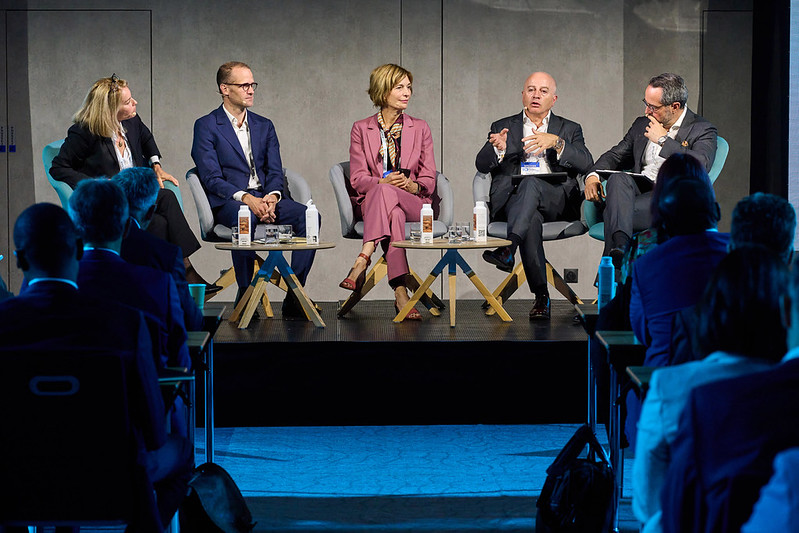
Left to right: Julia McKenny, CEO, ISSA; Pierre Davoust, Head of Euronext Securities; Marianne Demarchi, Chief Executive Europe and Global Securities, Swift; Philip Brown, CEO of Clearstream Banking SA (part of the Deutsche Börse Group); Rafael Moral Santiago, (then) Head of Securities Services at SIX
EU’s sovereignty quest
The European Union’s Market Integration and Supervision Package (MISP)2 aims to “eliminate barriers to integration in trading, post-trading, and asset management” and “enable market participants to operate more seamlessly across Member States, thus reducing cost differences between domestic and cross-border transactions”. With the goal of strategic autonomy and creating a single capital market for Europe, the package targets fragmentation and structural barriers to competitiveness identified in the Draghi Report.3
MISP focuses on Europe’s fragmented central securities depositories (CSDs)4 network, comprising 41 national and international CSDs, each with its own rules and priorities, with harmonisation measures to improve cross-border settlement and connectivity for investors.
These measures include simplifying CSD passporting rules and harmonising settlement finality through an EU regulation. Central to this is a proposed hub-and-spoke settlement model for Europe: a network formed by requiring hub CSDs to connect and requiring non-hub CSDs (the ‘spokes’) to connect to at least one such ‘hub’. This would be leveraged by the requirement for CSDs to connect to TARGET2-Securities (the cross-border settlement platform, T2S) for the settlement of securities in the currencies that T2S serves.
During a regulator update session at TNF, Sebastijan Hrovatin, Deputy Head, Financial Markets Infrastructure unit at the European Commission explained, “The aim is to spur competition among CSDs thereby helping to build a more liquid capital market.”
Industry-led integration
Over time, Europe’s CSDs have evolved from purely domestic infrastructures into more interconnected actors, partly through industry initiatives such as T2S. CSD links and bridges have enabled some form of interoperability for cross-border settlement and harmonised processes across jurisdictions.
Recent integration initiatives include Euronext Securities’ Convergence Programme,5 which is creating a single, harmonised post‑trade platform across its five CSDs, and new interoperability‑CSD links between Euroclear, Clearstream and Euronext to give participants flexibility to choose where they connect and settle.
An Association for Financial Markets in Europe report on high settlement costs6 reveals custodians favour integration via harmonised frameworks such as T2S and functional alignment, much like the central counterparty interoperability model, where clearing houses have open access to give their users choice.
T+1 and settlement resilience
With firms in the UK, Europe and Switzerland facing a T+1 settlement transition deadline of 11 October 2027, the Value Exchange’s 8 June 2026 T+1 Pulse survey of more than 600 market participants puts active engagement in preparations at 83% and 80% for UK and European firms respectively,7 with full readiness “remaining limited”.
At TNF, the focus was T+1 readiness with a lens on T+0 in a panel looking at the ‘future of settlement and beyond’. The core message from Nadine Readie, Global Product Lead, Custody and Clearing, Trust and Securities Services at Deutsche Bank, was that the biggest operational hurdle clients face right now is data readiness. In practice, this means accuracy, quality, and having the right information available early enough to support T+0-style processes. It requires unified front-to-back-office communication chains to manage settlement risks, uninterrupted data flows, clear ownership, and the ability to equip teams with the right information before engaging with clients.
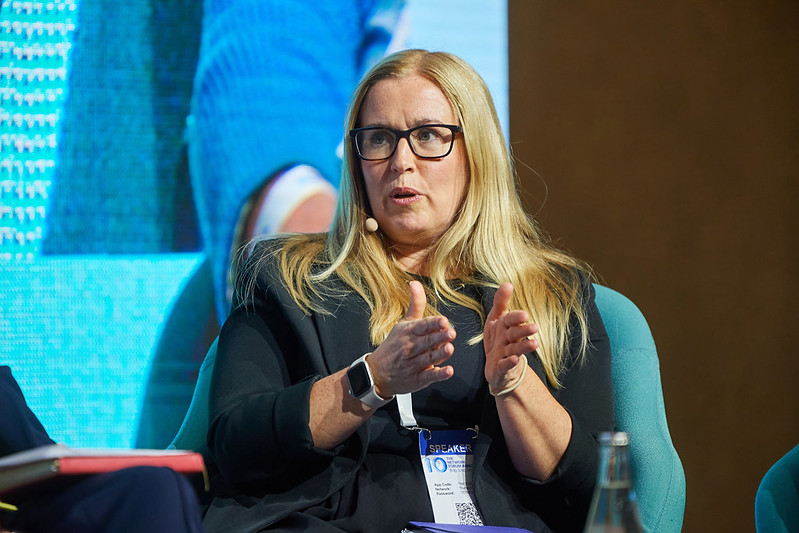
Nadine Readie, Global Product Lead, Custody and Clearing, Trust and Securities Services at Deutsche Bank, explains the core challenges clients face in compressed settlement cycles
T+0 and market resilience
T+0, or instant settlement with 24/7 trading, is some five to seven years away, and is contingent on liquidity, funding and market design catching up. Similarly, TNF delegates agreed tokenisation will enable real-time markets when assets and cash can move 24/7, be reused as collateral, and operate on the same chain.
Digital money assets, especially stablecoins, can remove some frictions, particularly around cross-border FX. As Anand Rengarajan, Head of Sales, Trust and Securities Services APAC, Middle East and Africa at Deutsche Bank put it in a panel: “If cross-border payments move to stablecoins, some of the FX availability problem goes away, but the real challenge is liquidity and funding, and that’s where the market has to come together.”
On stablecoins TNF delegates unanimously agreed that cash on chain – via stablecoins – is an essential requisite to moving T+0 beyond theoretical. While FX and cross-border timing was the biggest barrier to moving from T+1 to T+0 in global markets, according to the audience poll, market infrastructure and local regulations came a close second.
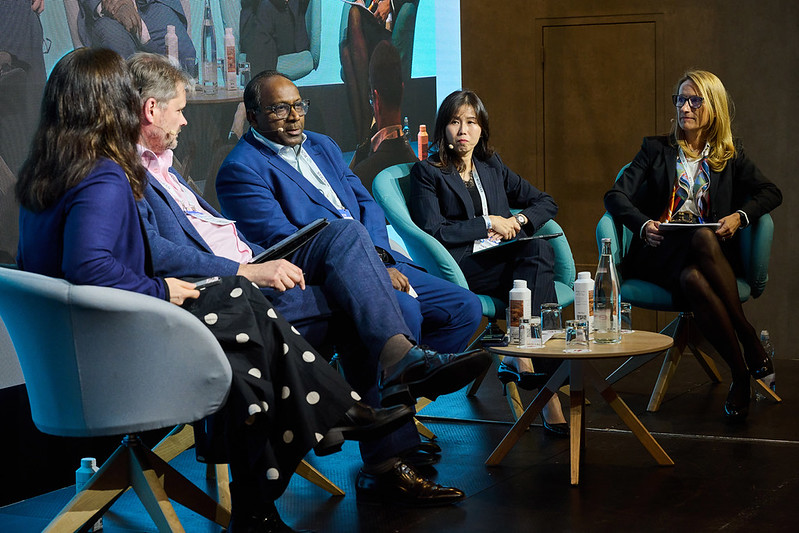
Left to right: Virginie O’Shea, Founder, Firebrand Research; Daniel Carpenter, CEO, Meritsoft; Anand Rengarajan, Head of Sales, Trust and Securities Services APAC, Middle East and Africa at Deutsche Bank; Ying-Ying Tan, Global Head of Product Management, Standard Chartered; Julia Barbara Romhanyi, Global Head of Securities Services, UniCredit
A tokenised framework
As global markets direct energy towards digital asset developments, TNF discussions centered on interoperability between tokenised and traditional systems, and co-existence between digital and traditional money.
Project Agorá’s shared programmable platform for wholesale cross-border payments8 and the Pythagore collaboration between Euroclear and Banque de France9 to tokenise short-term debt show how Europe is moving in a slightly different direction to the private-led initiatives. The European approach is more public sector driven, with central banks playing a leading role. This stands in contrast to the US, where stablecoins are currently the main driver of private sector digital money innovation.
However, the TNF audience poll indicated that Europe’s focus should be on a combination of all types of digital money – see the flow whitepaper, ‘Digital Money – a perspective on stablecoins, token-ised deposits, and CBDCs’.
This makes the interoperability challenge greater. Marco Kessler, Head of Product and Business Development, Digital Assets at SIX, the Swiss CSD, described it as a shift from a “relay race” of sequential handoffs to participants running in sync toward atomic settlement and instant finality.
Speaking at TNF he explained that the recent decision to bring the digital and traditional CSD at SIX into one legal entity10 was not about building another separate infrastructure multi-ledger access but providing “one plug to two worlds and giving users optionality and interoperability between traditional and digital worlds”.
Proliferating DLT platforms are creating fragmented digital islands at the TradFi–DeFi intersection, and Swift is responding with a blockchain‑based interoperability layer that links platforms, moves value securely, and, in the words of the Belgian-based cooperative’s Kelli West, Global Head of Securities and FX Strategy, “bridges those islands using proven connectivity and standards while that fragmentation eventually resolves into consolidation”.
The future: back to equilibrium
While current forces tip the post-trade resilience-innovation balance toward defence and protection, there was a sense at TNF 2026 that AI and digital assets will likely rebalance the scales once operational complexity around safekeeping, cold wallets, segregation and new governance models is resolved. That future lies in the convergence of TradFi and DeFi, where custodians’ essential functions such as paying agent, reconciliation, and pre-funding aren’t replaced but extended, underpinning the trusted infrastructure the new world will continue to depend on.
Natasha Poole, Head of Network Management at State Street, spelled it out: “You can’t operate at scale and run two separate platforms.” To do so could end up being something of an own goal…
This article is based on panel discussions at The Network Forum Annual Meeting, which took place from 8–10 June 2026 in Paris.
Janet Du Chenne is a freelance financial journalist and a former Co-Editor of flow
Embedded panel images: © The Network Forum
Sources
1 See Beneath the Asset Survey at thomasmurray.com
2 See EU Market Integration and Supervision Package at finance.ec.europa.eu
3 See Draghi report on EU competitiveness at commission.europa.eu
4 See About ECSDA at ecsda.eu
5 See Euronext Convergence Programme at euronext.com
6 See EU Investors Losing Out from High EU Settlement & Custody Costs Charged by CSDs at afme.eu
7 See T+1 2026 Q1 Pulse Survey at thevx.io
8 See Project Agorá: a shared programmable platform for wholesale cross-border payments at bis.org
9 See Banque de France and Euroclear to tokenise short term debt in Paris at euroclear.com
10 See SIX receives approval to merge digital CSD into SIX SIS AG at six-group.com


You might be interested in

Trust and securities services
Custody in an age of fragmentation Custody in an age of fragmentation
How are global custodians navigating the fragmented geopolitical landscape? And what’s their take on digital assets and artificial intelligence? flow shares insights from BBH, Clearstream, JP Morgan and State Street
Custody in an age of fragmentation More
Trust and securities services
Shifting gears Shifting gears
A tipping point for the tokenisation of structured products and securities, enabled by issuer and investor services, might finally be upon us predicts Deutsche Bank’s Paul Maley. Speaking to Janet Du Chenne, he makes clear that client voices and market shifts are pushing the industry toward a more unified model

Trust and Securities Services
Europe’s T+1 transition: lessons, readiness and what firms need now Europe’s T+1 transition: lessons, readiness and what firms need now
With Europe’s October 2027 T+1 transition deadline now firmly in scope – and its practical complexities crystallising – flow securities services correspondent Janet du Chenne meets the Deutsche Bank Trust and Securities Services team translating US lessons, internal readiness work and industry guidance into coordinated client action