
-
Cash Management
Building on today’s payment foundations
Tokenised money and artificial intelligence (AI) may be reshaping the payment industry, but progress still depends on the underlying infrastructure, standards and data. What comes next for cross-border payments after Sibos 2026?
MINUTES min read
Change in payments is often framed as a choice between evolution and revolution. But as new technologies, infrastructures and forms of money develop alongside existing payment systems, the distinction between the two is becoming harder to draw. As Swift CEO Javier Pérez-Tasso put it during the opening plenary of Sibos in Miami: “The question is not anymore about TradFi or DeFi. It’s not either/or.”
This relationship was a recurring theme across this year’s Sibos. While AI and digital assets dominated many of the conversations, they also raised a more fundamental question: how can the industry build on the foundations already in place to support the next generation of payments?
In the first of two wrap-ups, flow examines how existing payment rails are evolving to meet changing client needs in an always-on, 24/7 world. The second article explores how tokenised money and AI could reshape payments and correspondent banking.
Swift scheme: extending reach, preserving consistency
Announced in September 2025, the Swift payments scheme provides a common rulebook for cross-border payments, covering fee and FX transparency, full-value delivery, end-to-end tracking and faster settlement where domestic infrastructure allows.1
A year on, progress is visible across several corridors. In June 2026, for example, Deutsche Bank completed its first live transactions under the scheme, acting as gateway intermediary for euro payments into Germany from Australia, in collaboration with Westpac, and from Brazil, with Itaú.2
At Sibos, attention turned to the Europe–India corridor. The route is particularly significant: India is the world’s largest recipient of remittances, while the free trade agreement signed in January 2026 is expected to boost trade between the two regions.3
The session ‘The Swift payment scheme in action: connecting Europe and India’ brought together the banks involved in activating the corridor: Axis Bank and BNP Paribas as debtor agents, and Axis Bank, BBVA and Deutsche Bank as gateway intermediaries into India, Spain and Germany respectively. Transactions under the scheme have already demonstrated the potential speed of the model, with payments into India completed in as little as 40 seconds, significantly improving the end-to-end experience.
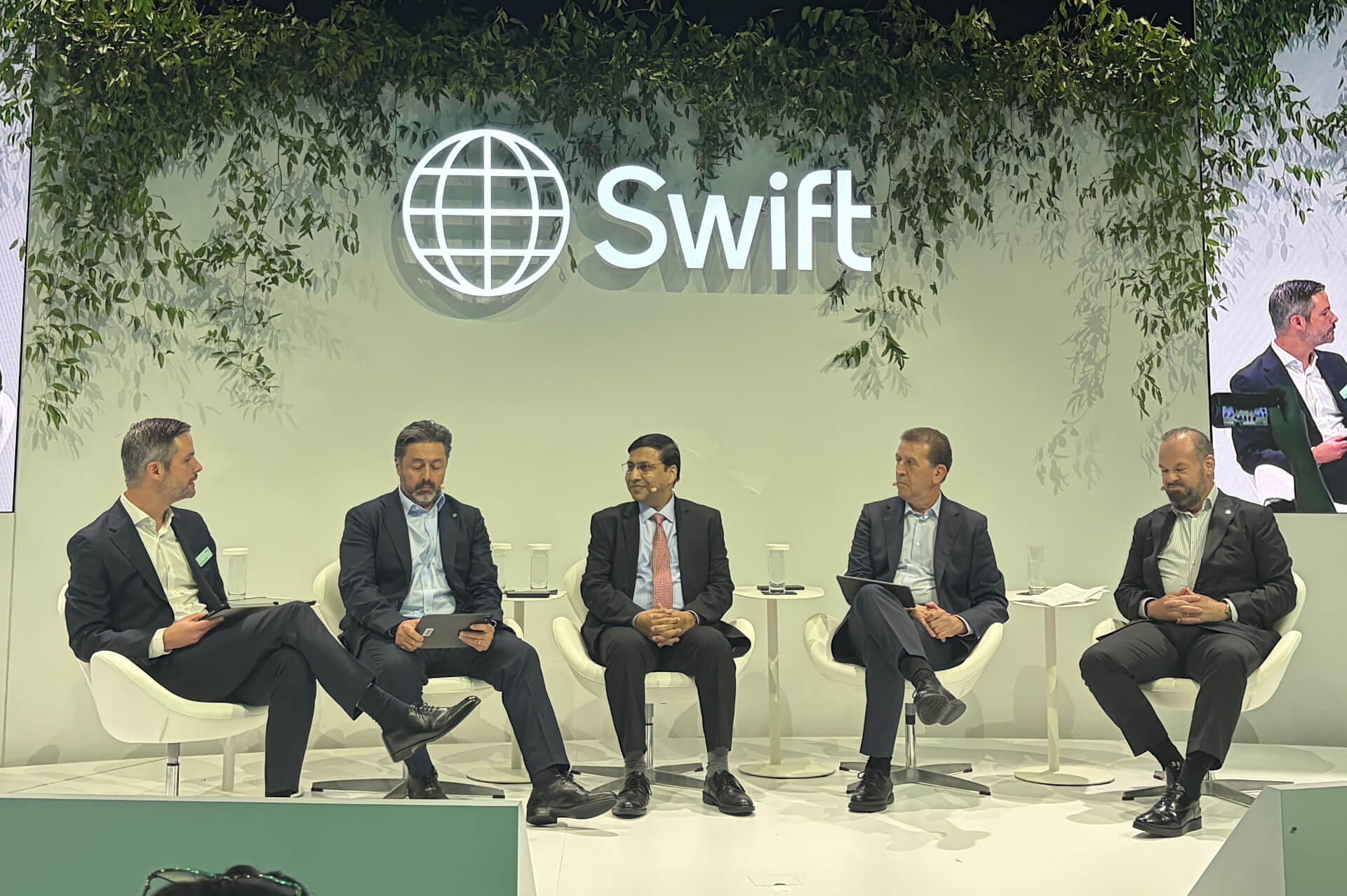
From left to right: Moderator: François Maigre (Swift), Bruno Mellado (BNP Paribas), Vineet Agrawal (Axis Bank), Raouf Soussi Laghmich (BBVA) and Ciarán Byrne (Deutsche Bank)
Looking ahead, the Spanish market offers a useful glimpse of how the model could develop across Europe. Here, the Swift payment scheme is being combined with the European Payment Council’s One-Leg Out Instant Credit Transfer (OCT Inst) scheme, where the relevant domestic instant-payment infrastructure already offers reachability of up to 95%.
“We have found that we don’t have to develop or implement new infrastructure,” said Raouf Soussi Laghmich, Head of International Solutions at BBVA. “We just have to reuse what we have locally that is working and is in place, and integrate the two schemes,” enabling participating banks to offer customers a domestic-style, real-time payment experience.
The challenge, however, is making that model repeatable across markets with very different domestic rules, processes and exceptions. “Individually, these may be relatively small differences, but together they can create considerable friction – making it important to establish a minimum set of common rules across participating markets,” said Bruno Mellado, Head of Payments at BNP Paribas.
That need for a common foundation becomes even more important as the initiative expands. “The last thing we want is to have essentially 100 different versions of the scheme in every country where we’re operating,” added Ciarán Byrne, Head of Product & Market Management – Institutional Cash Management at Deutsche Bank.
The experience so far has also shown that achieving that consistency requires participants to identify and work through local exceptions together. Early implementation resulted in a high level of payment rejections, requiring collaboration across the community to understand the causes and bring those rates down.
Ultimately, the onus will be on banks to manage these layers of complexity while shielding customers from them. As Byrne put it, clients “don’t want an explanation of the architecture or the complexity behind it. They want to see the outcome”. That underlying architecture could become more diverse still. “I suspect that within the next 12 months we may even see a scheme payment settled by blockchain for the last leg,” he said. “The ultimate hope is that, by then, we no longer call this a scheme payment. We just call it a payment.”
There is also an ambitious roadmap ahead to bring the scheme closer to this vision. In an earlier session, Nick Kerigan, Head of Innovation at Swift, highlighted three key priorities for the next stage of development:
- Scale: Expanding participation, with 13 destination markets live at the time of Sibos and more than 19 expected by the end of 2026.
- Functionality: Evolving the rulebook – with an update planned for December 2026 – to support additional use cases, including foreign currency settlement, aggregator models and connectivity to more last-mile rails.
- Optionality: providing greater choice beyond the account-to-account model.
Towards data quality
At its heart, ISO 20022 is about data – creating richer, more structured information that can be processed consistently across the payment chain. Improving the quality of that data can support greater automation, more effective compliance and better customer outcomes, while also providing a stronger foundation for emerging applications of AI.
One important part of that effort concerns postal address data. Swift had originally planned to remove the option to use unstructured postal addresses from 14 November 2026, allowing only fully structured or hybrid addresses, with town and country provided in designated fields at a minimum. However, on 27 August, Swift extended the deadline after readiness monitoring showed that large parts of the industry across all regions would not be able to meet the address requirements in time.4
The work left to do was evident during the Sibos session ‘Nobody likes rejection: don’t let address data issues impact your customers’. Elena Hergass, Head of Product Management – Institutional Cash Management at Deutsche Bank, cited Swift figures showing that, as of September 2026, 51% of debtor addresses were not structured to the expected standard, rising to 53% on the creditor side. Combined, she said this meant at least 60% of payments could have been rejected had the requirement been enforced as planned.
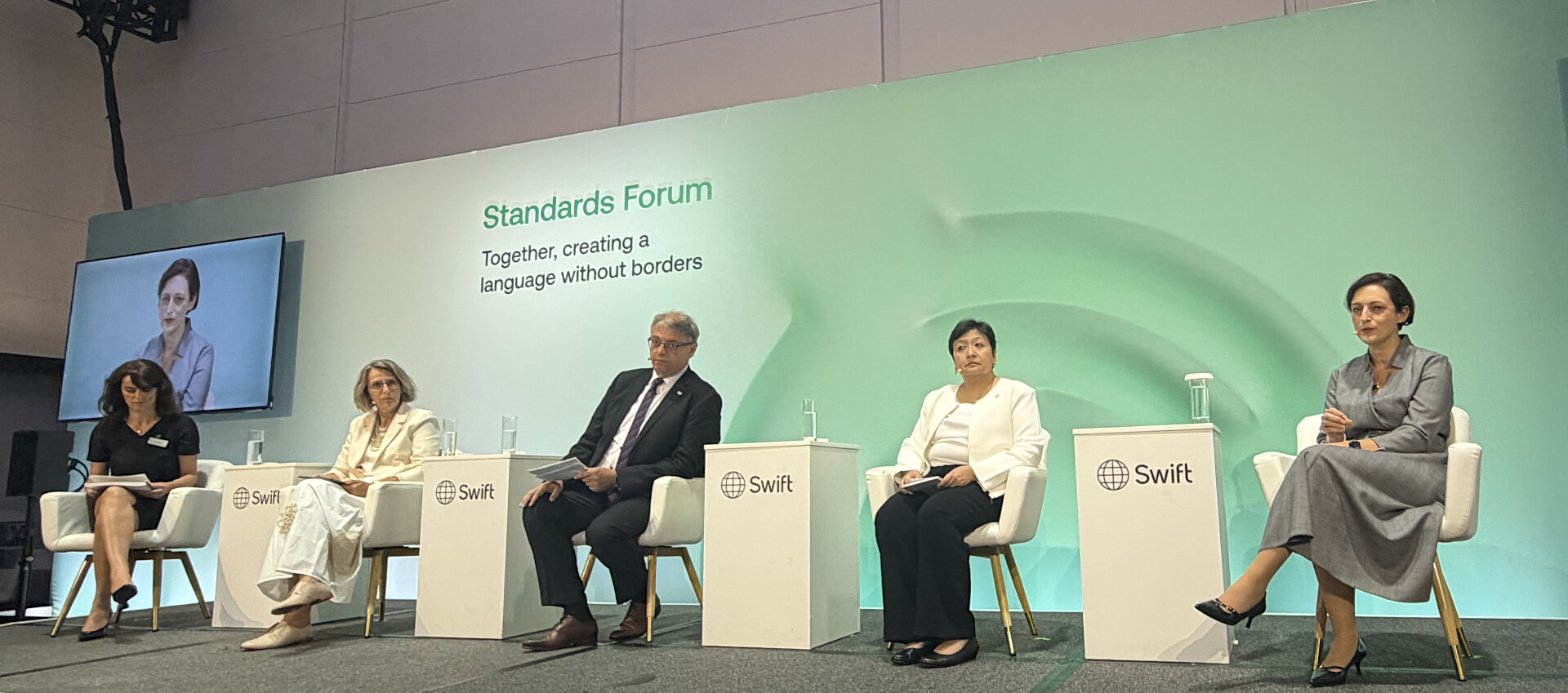
From left to right: Moderator: Liza Januzi (TD Securities), Dana Brants (Swift), Mario Reichel (PPI AG), Celia Ardyasa (Commonwealth Bank of Australia) and Elena Hergass (Deutsche Bank)
So how did the industry get here? “A lot of institutions focused on just the message standards, or the system upgrades, or the network connectivity,” explained Celia Ardyasa, Director, International Network Management, Commonwealth Bank of Australia. “But then they discovered that the challenges actually were further upstream in their enterprise resource planning (ERP) platforms or their customer data databases – and these were proving to be the real challenge.”
The scale of that internal complexity was underlined in another session on the topic, where one panellist revealed that a major international bank had to modify 250 separate back-office systems to achieve end-to-end compliance for structured address fields – before accounting for the changes required across client systems.
The corporate side faces a similar challenge. While banks can provide guidance, the underlying information often needs to be remediated at source. That requires corporates to assess the quality of data held in ERP and treasury systems and work with banks and technology providers to address gaps through testing.
To navigate the dual challenge of readying internal and external systems, the transition, according to Hergass, needs to be approached as an end-to-end lifecycle programme. “Engaging clients early helped build awareness and connect at senior levels to prioritise budgets. Then it is a case of testing, reviewing the results, collecting the data and feeding that back to identify what still needs to happen,” she said.
While that work continues across the ecosystem, the extended deadline should not hold back institutions that are already prepared: “If you are ready, switch it on because it will help the rest of the industry as well and give the confidence and the trust that we are moving collectively where we want to go,” said Dana Brants, Head of Standards and MI at Swift.
Bringing exceptions and investigations up to speed
Although only around 2%-5% of payments result in enquiries, at industry scale this still translates into millions of cases each year – and resolution can still take days or even weeks.5
Part of the challenge lies in the way exceptions and investigations (E&Is) have traditionally been communicated between parties. Banks rely on MT199 and MT299 messages, in which 72% of the data fields used for E&I cross-border messages are free format.6 This creates lengthy, conversational exchanges that require operations teams to first interpret the request, identify the underlying payment and, in some cases, go back to the sender for additional information before the investigation can properly begin.
“When you receive these messages and try to understand what the requester is actually asking, you often need to start investigating the investigation to better understand what the actual problem is,” said Paula Roels, Head of Swift & Industry Engagement, Deutsche Bank.
The industry’s response is to bring greater structure and standardisation to E&Is through ISO 20022. The new camt.110 and camt.111 messages are designed to replace free-format exchanges with defined investigation types, while the Unique End-to-End Transaction Reference helps link an enquiry to its underlying payment. A new end-to-end investigation reference, meanwhile, stays with the case throughout its lifecycle, supporting end-to-end tracking as the investigation moves between parties.7
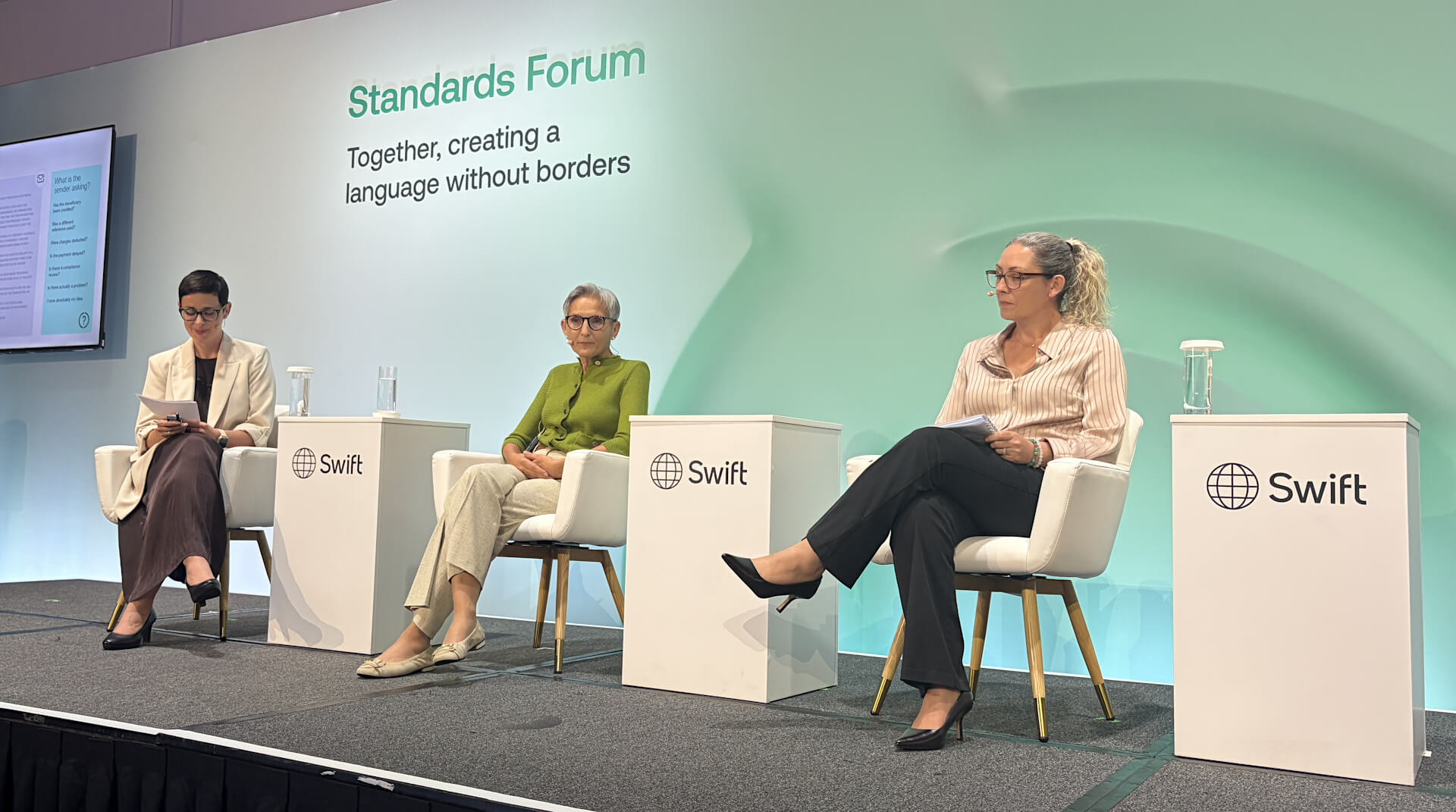
From left to right: Moderator: Monika Komar (Swift), Paula Roels (Deutsche Bank) and Chloe Jenkins (Barclays)
But standardised messages are only one part of the equation. Swift’s case management framework is designed to orchestrate how investigations move between institutions, drawing on information already available through the payments tracker. “ISO 20022 brings a language, and case management brings the orchestration,” added Monika Komar, Head of Case Management (E&I), Swift.
This allows, or is intended to allow, an enquiry to be directed towards the institution best placed to resolve it, based on where the payment sits in the chain. In some cases, information already available through the tracker could be sufficient to answer the enquiry automatically, avoiding the need for additional institutions to become involved.
The potential gains are significant. Swift estimates that the new framework could reduce resolution times by up to 80% for non-complex cross-border investigations and up to 75% for domestic investigations. It also estimates that industry-wide adoption could unlock more than US$600m in annual value through lower operational costs and reduced liquidity impacts.
More than 330 institutions are already live on case management, and over 450 have subscribed – together representing around 70% of the estimated value associated with E&Is. For Chloe Jenkins, Lead Business Analyst, Barclays, one of the key lessons from their early adoption was the importance of making this business case tangible.
Jenkins added that “E&I had historically received less attention than payment processing itself, but once senior stakeholders began quantifying the cost of opening and handling cases – including cases that could potentially be avoided altogether – support quickly followed”.
The next milestone is the coexistence phase, currently targeted for June 2027. Institutions unable to process the new messages directly will initially be able to receive translated versions containing embedded MT199 messages. However, the panel warned that this should not be treated as a simple continuation of existing processes.
“This is a business transformation, not just a message migration,” Jenkins concluded. “Familiarise yourself with the new rulebooks, adjust your automation processes and start talking to stakeholders across the institution as early as possible.”
Sources
1 See Swift to set new rules for retail cross-border payments on its network in bold move to further ramp up speed and predictability at swift.com
2 See Swift goes live with payments scheme to tackle cross-border payments’ last-mile challenge at corporates.db.com
3 See India nails her trade credentials at flow.db.com
4 See Swift accepts community request to extend structured address migration for ISO 20022 payment messages at swift.com
5 See Use case 2 - Improve payments exceptions and investigations at swift.com
6 See It’s time to transform exceptions and investigations at swift.com
7 See Guide to ISO 20022 exceptions and investigations (E&I) migration and case orchestration at flow.db.com


You might be interested in

Cash management
How Swift is adapting to the changing payment ecosystem How Swift is adapting to the changing payment ecosystem
Cross-border payments are being reshaped as new models around distributed ledger technology and digital money emerge. flow explores the role Swift continues to play

Cash management
How can banks become traffic controllers for payments? How can banks become traffic controllers for payments?
Instant payments, digital assets and richer data are changing what clients expect from their banks. The challenge is no longer simply to move money, but to decide which route it should take – and develop a new business model around it. flow shares reflections from EBAday 2026 in Copenhagen

Cash management
Inside downstream correspondent banking – and why it matters Inside downstream correspondent banking – and why it matters
As regulation and standards evolve, the view of risk linked to downstream correspondent banking relationships is also changing. Deutsche Bank’s Matthew Probershteyn explores this shift in perception – and examines how banks are strengthening both control frameworks and transparency in practice