
-

Cash management
Transaction banking global leaders: a view from the top
Transaction banking is “unique”, “cool”, and “connects our clients to the real economy”, according to the global leaders panel finale at the BAFT Europe Forum in London. flow’s Clarissa Dann reports on their reflections ranging from payments transformation and AI applications to strategic partners and talent attraction
MINUTES min read
The final session of the 3–5 March 2026 BAFT Europe Forum, ‘Transaction Banking Global Leaders – A View from the Top’, gave the event’s 400 delegates the opportunity to hear how global transaction banking heads see payments transformation, AI applications, future partnerships, and talent attraction within their businesses and the wider ecosystem.
This article distils some of the key messages and, together with the panel moderator Dean Sposito, Head of Institutional Cash and Trade, Western Europe at Deutsche Bank, the flow team is grateful to Standard Chartered, Santander and Nordea for their leaders’ insights.
This follows the earlier BAFT Europe Forum flow report featuring the insights of Deutsche Bank’s Head of Corporate Bank and Investment Bank and Management Board member, Fabrizio Campelli.
The panel
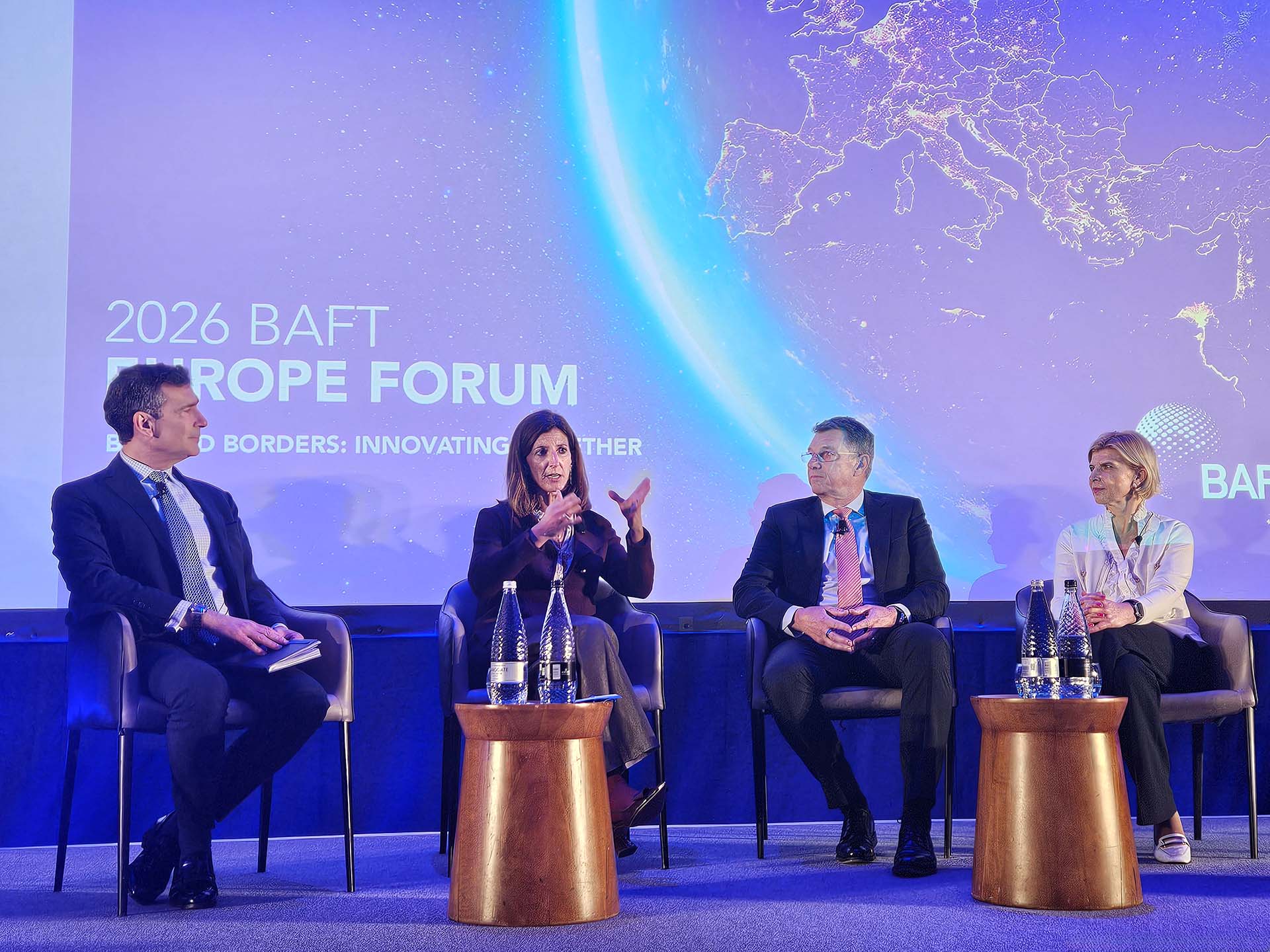
Left to right: Dean Sposito, Head of Institutional Cash and Trade, Western Europe, Deutsche Bank (Moderator); Mencia Bobo, Global Head of Global Transaction Banking, Santander CIB; Michael Spiegel, Global Head of Transaction Banking, Standard Chartered; and Kirsi Wiitala, Head of Transaction Banking, Nordea. Image: © BAFT
Dean Sposito: The selection of the banks on this panel – Standard Chartered, Santander and Nordea – are very intentional; it’s interesting to see how banks with transaction banking businesses are unique. From my perspective, one thing that does connect all four of us is how these businesses connect our clients to the real economy globally – so they can achieve their goals and be successful. Let’s now move to what is going on in the industry (and a lot has happened in the last few days) – what are you seeing both in terms of challenges and opportunities?
Kirsi Wiitala: One opportunity is regulation – you might remember in the Nordics we had an ambitious plan to have one clearing house to cover for countries and currencies which, in the end, unfortunately was not successful.1 Today, Nordic markets remain partly fragmented, but at the same time all markets are rapidly modernising their payment infrastructures. This is reflected in a very active roadmap for us – and, importantly, it delivers tangible benefits for our customers.
Another interesting shift is what is happening to traditional payment chains. In the past everything was done through banking channels. Now you see payments are initiated by corporates and consumers in wallets and on different platforms. Those platforms can decide what payment optionalities are provided for customers and determine the rails underneath – shifting where the value sits. In the Nordics the account-to-account payments have grown by more than 25% for instance in ecommerce year on year,2 underlining the importance of providing value-added services to protect banking revenue pools.
Mencia Bobo: I think we can agree that transaction banking is facing the most systemic change it has seen in decades. It’s been seen as key infrastructure, a provider of more organised solutions, and stable balance sheets. If you look at everything that is happening now – climate-related requirements, tensions around supply chains and transportation – clients are asking for different types of solutions. They want visibility, they want solutions in real time, they want liquidity buffers and solutions embedded in their own organisation and that we orchestrate demo systems. This all means we are moving from a more passive role to a very active role with this integration of our clients. Digitalisation, digital assets, artificial intelligence are all just tools and not the final goal – they need to become part of what our clients want us to be.
Michael Spiegel: Payments is a cool business – everyone wants to be part of it. I think transaction banking is an exceptional business because, as you say Dean, we deliver solutions to the real economy. We are ‘the three Cs’: competitors to each other, clients, and we all collaborate and work together.
On a macro level, our industry is coming to another inflection point. It is hard to find the right balance between how much we can innovate and which innovation we should invest in. The real challenge is to find the right solution to stay relevant to clients and keep investing and embracing the right technology to offer relevant capabilities and client solutions.
“We have all these innovations and developments but the traditional rails will co-exist for years to come”
Dean Sposito: I think the businesses we are in right now are so dynamic that it almost mirrors the speed at which things are happening with our industry. Clearly, we have all these innovations and developments but at the same time we know the traditional rails will co-exist for years to come. That puts a burden on our investment budgets. How do we choose? Do we have to do everything? Can we partner on some things? For example, Michael – we both have an equity stake in Partior.
Michael Spiegel: We must continually invest and upgrade our existing technology. In fact, we at Standard Chartered are in the midst of re-platforming our payments infrastructure to be more interoperable with peers and to integrate with emerging and new payments methods such as digital assets. The reality is that corporate customers don’t want to deal with 40 different banks and solution providers. The BAFT Transaction Banking Global Leaders Group is a great platform for us to collaborate and work with our peers to deliver solutions that meet our clients’ needs.
Mencia Bobo: Just to add that from Santander’s perspective we are indeed following up on all the different trends. For some we have a more active role and for others we are more of a participant. These conversations are really important and each of us can share our capabilities. Sometimes we need to hold off investing in things just because they sound fancy, but we need to look to ourselves and our infrastructure about what could be a success.
Dean Sposito: From my side it’s important to identify things we all do independently that are not high value where there is a lot of duplication – such as KYC.
But let’s now look at our industry. We can see from the Future Leaders Programme that people are interested in transaction banking and the businesses we do – and the connection with clients and the real economy. In your institutions, how do you see the talent pool? Can you retain and attract new talent?
Mencia Bobo: I think we could do better in communicating all the good things about this business and this is always a challenge for talent attraction. It’s probably the most complete business in terms of the profile you need to have – technology, financial skills and a drive for innovation. While we have initiatives such as the Future Leaders Programme, etc, each one of us in our banks could be more active.
Kirsi Wiitala: It’s recognised all through the industry as a really important area – not just because of the digital solutions and innovation and the exciting things that are happening, but also because it is the foundational engine that embeds us deeply in our customers’ everyday operations.
The 2026 BAFT Europe Forum took place from 3–5 March 2026 in London
Sources
1 See How P27 Will – No Longer – Transform Trade in the Nordics at britepayments.com
2 See The 2025 McKinsey Global Payments Report: Competing systems, contested outcomes at mckinsey.com and The Future Is (Anything but) Stable at bcg.com


You might be interested in
TRADE FINANCE, CASH MANAGEMENT
Five drivers of transaction banking’s direction Five drivers of transaction banking’s direction
How will ISO 20022, sustainability, digital currencies, sanctions and trade digitalisation shape the future of transaction banking? flow summarises the top five takeaways from the Bankers Association for Finance and Trade’s (BAFT) 2023 Europe Bank to Bank Forum

Trade finance and lending, Macro and markets
Europe’s energy stress test Europe’s energy stress test
How will this latest Iran oil shock impact the global economy, and what does this mean for ramping up Europe’s competitiveness? flow’s Clarissa Dann shares geopolitical insights from expert speakers at the 3–5 March 2026 BAFT Europe Forum
flow case studies, Cash management, Trade finance and lending {icon-book}
Brazil’s gateway to global trade Brazil’s gateway to global trade
How can Brazilian businesses finance cross-border trade in a volatile global landscape? Drawing on the example of Banco do Brasil – the country’s second-largest bank – flow explores the role that correspondent banking plays in enabling these transactions