
-

flow case studies, Trade finance and lending
Financing Dar es Salaam’s new bus network
As bus rapid transit (BRT) systems in Africa continue to expand in response to increased urbanisation, flow’s Clarissa Dann profiles the roll-out in Tanzania’s Dar es Salaam and spotlights how a trade finance partnership with a local bank using a letter of credit got the wheels turning
MINUTES min read
On 10 May 2016, the Government of Tanzania began operations on its Dar Rapid Transit bus system to improve transport mobility, accessibility, safety, and quality of transport service delivery along selected corridors in Dar es Salaam.
The city is Tanzania’s commercial hub, its largest city and the third fastest-growing in Africa – and the ninth fastest-growing in the world. By the end of 2025 its population stood at 8.8 million having expanded by more than 4.8% on the previous year.1
According to a 2024 Tanzania National Roads Agency report, the rapid population increase has been posing a number of development challenges including: “development of unplanned settlements (about 70% of the city’s population lives in unplanned areas), traffic congestion, poor and insufficient social and economic services, land use conflicts and environmental degradation”.2
Bus rapid transport systems
Bus rapid transit (BRT) systems in Africa are designed to provide efficient, high-capacity public transport services, often in response to rapid urbanisation, increasing traffic congestion, and the need for more sustainable mobility solutions. They aim to offer a more attractive alternative to traditional buses and private vehicles by incorporating features typically found in rail-based systems, but at a lower cost.
The first BRT system was launched in Lagos on 17 March 2008, preceding Rea Vaya in Johannesburg, South Africa. More followed in the main South African cities, with BRT systems also now present in Nairobi, Accra, Abidjan, Dakar, Kampala and Cairo. In the case of the Dar es Salaam BRT, buses are powered by compressed natural gas (CNG) and have been imported from China.
To accommodate its rapid expansion, the Tanzanian government has invested more than US$300m in the Dar es Salaam BRT since its launch. However, by 2025, it became clear that additional CNG buses were needed, and an agreement was reached with the top bus manufacturers in China to supply them.
The Dar es Salaam BRT service is delivered by the UDA Rapid Transit Public Limited Company (UDART), an entity in which the Government of the United Republic of Tanzania is the majority shareholder. UDART has been operating a fleet of buses that serve an average of 165,000 passengers per day since May 2016. Currently, the Dar es Salaam BRT system has more than 45 bus stations and five terminals at Kimara, Ubungo, Morocco, Gerezani and Kivukoni. The length of BRT phase one routes cover a total of 20.9km. UDART operates its bus fleet for a period of 19 hours per day, starting at 4:30am and ending at 00:00pm.
Financing the buses
While the government of Tanzania has provided a significant proportion of the finance – particularly for local costs and land acquisition – the Dar es Salaam BRT network, also known as DART, was financed by a consortium of international institutions. Multilateral funders that provided support with the large-scale public infrastructure project included:
- The African Development Bank;3
- The World Bank (International Development Association );4
- The Global Environment Facility;5 and
- The European Investment Bank.6
Typically, commercial banks support with financing agreements for the buses or specific tenders, rather than the overall infrastructure project. An example of this in action is Deutsche Bank’s mandate for confirmation of a letter of credit (LC) issued by Tanzanian local bank CRDB Bank in favour of one of the top three Chinese bus manufacturers. Its buses have been exported to around 120 countries and regions worldwide. Here, the LC supports CNG buses to serve the Dar es Salaam BRT system, as well as Tanzania’s wider energy transition objectives.
Trade finance is often used in situations where counterparties do not have a long trading history with each other (where open account is usually the route taken7). Here, the LC became the financial anchor needed to deliver the vehicles for the BRT expansion. But executing such a transaction across jurisdictions with vastly different risk profiles and regulatory frameworks required capability in structuring, mitigating and bridging risk across several continents.
By confirming and discounting the LC through its Hong Kong hub, Deutsche Bank provided a 2.5 year all in tenor with a two year discounting period, enabling early payment to the manufacturer and delivery of the buses to Tanzania, thereby supporting the manufacturer’s cashflow, and helping extend credit terms to the buyer, while preserving the financial stability of the project. Behind the scenes, Deutsche Bank orchestrated a coordinated effort spanning China, Tanzania, Singapore, Germany and the UAE.
“Transformative projects such as the Dar es Salaam BRT are critical to the country’s economic growth and development”
The treasury advisory team guided the supplier through overseas LC requirements; trade finance specialists aligned on structuring and execution; and a longstanding relationship with the Tanzanian issuing bank, CRDB Bank PLC, ensured clear communication and mutual confidence. The LC was advised and confirmed on the same day.
Supporting frontier markets
“This transaction illustrates how Deutsche Bank’s global platform can convert a complex infrastructure aspiration into a functioning, real world solution,” reflects Anand Jha, Global Head of Trade Finance Financial Institutions at Deutsche Bank. He continues, “As additional phases of the BRT programme continue to move ahead, the foundation laid in this initial stage underlines the bank’s role in supporting frontier markets along with a commitment to sustainable mobility for millions.”
Group CEO and Managing Director of CRDB Bank PLC, Dr Abdulmajid Mussa Nsekela, adds, “As Tanzania’s leading bank, CRDB is proud to support transformative projects such as the Dar es Salaam Bus Rapid Transit, which are critical to the country’s economic growth and development. We are equally pleased to continue deepening our long standing partnership with Deutsche Bank, enabling us to deliver even greater impact in Tanzania and beyond.”
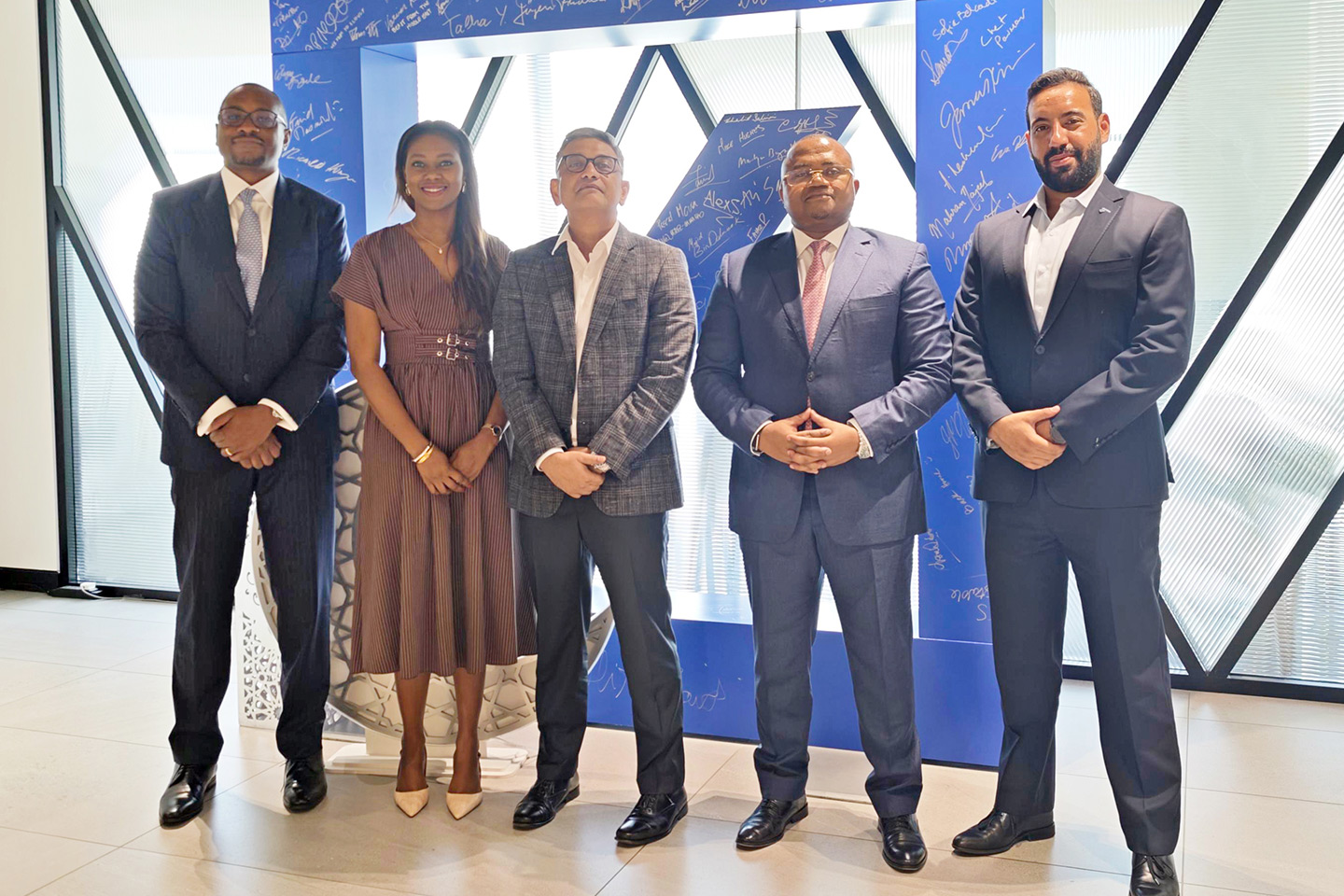
From left to right: Jackson Kehengu, Principal Representative & Country Manager, CRDB Bank PLC, DIFC Representative Office; Ndeye Rivet, Structured Trade & Export Finance MEA, Deutsche Bank; Anand Jha, Global Head of Trade Finance Financial Institutions & Region Head Trade Finance & Lending MEA; Dr. Abdulmajid Mussa Nsekela, Group Chief Executive Officer and Managing Director, CRDB Bank PLC; and Sabri Riache, Institutional Cash & Trade Client Manager, East and Southern Africa, Deutsche Bank.
Header photo source: World Bank Photo Collection | Flickr
Sources
1 See worldpopulationreview.com
2 See eib.org
3 See mapafrica.afdb.org
4 See worldbank.org
5 See thegef.org
6 See eib.org
7 See flow.db.com


You might be interested in
White papers/guides
A Guide to Trade Finance – Second edition A Guide to Trade Finance – Second edition
Following the success of our first edition in 2020, Deutsche Bank’s A Guide to Trade Finance returns with a fully updated second edition, covering core products, key standards, emerging technologies, and market participants. It also introduces new insights on risk management, trade finance distribution, and sustainable finance’s expanding role in global trade
Trade finance and lending, Macro and markets
What next for global energy? What next for global energy?
With a negotiated settlement to end the war in Iran not as yet confirmed, what does this mean for global trade with energy prices at current levels? flow’s Clarissa Dann examines insights from Deutsche Bank Research and key international agencies and reflects on what this means for trade finance demand
Trade finance and lending, Macro and markets
Commodities Outlook 2026 – where next Commodities Outlook 2026 – where next
Copper is up, oil down, but amid the uncertainty and volatility that characterises the current geopolitical landscape there is one constant – China. As the world’s second biggest economy enters its year of the Fire Horse, flow’s Will Monroe shares key updates from Deutsche Bank Research’s Commodities Outlook, where supply and demand is clearly linked to what China might do next