
Transcript - Episode 11: Why global pharmaceutical corporate Merck is switching to the ISO 20022 standard
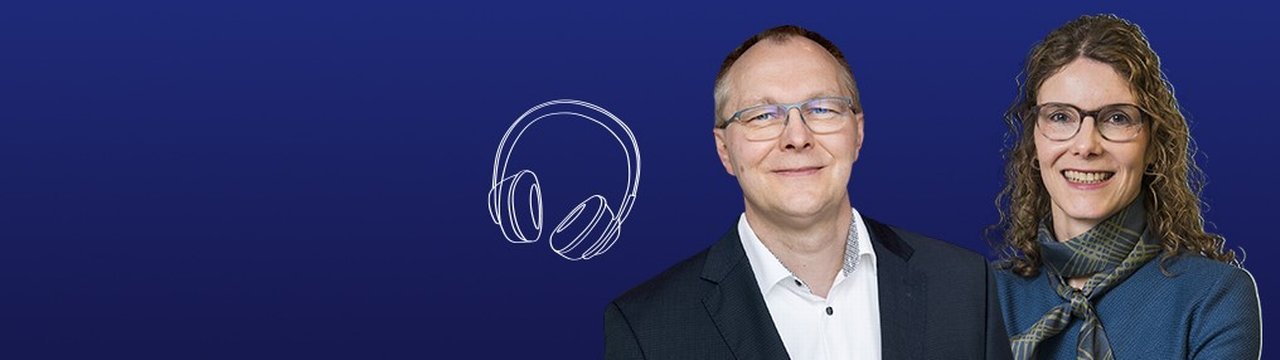
Guests:
- Uwe Reinemer, Head of Treasury Technology and Digitalisation at Merck
- Kerstin Schoenwitz, Director of ISO 20022 Corporate-to-Bank Standardisation/Global Formats, Deutsche Bank
Clarissa Dann (CD): Hello, and welcome to the flow InCorporate Treasury podcast, from Deutsche Bank Corporate Bank, that delivers insights straight from the source.
Today, we’re diving into a topic that’s gaining huge traction in the corporate world: ISO 20022. So, what exactly is this? In short, it’s a new, global messaging standard for financial transactions. Just think of it as upgrading from an old, limited language to a universal, rich, and highly structured communication protocol for payments and other financial data.
My name is Clarissa Dann and I’m the Editorial Director of flow. I’m delighted to be joined today by Uwe Reinemer, Head of Treasury Technology & Digitalisation at Merck. Merck is a global science and technology company headquartered in Darmstadt, Germany. Kerstin Schoenwitz, who is responsible for managing ISO 20022, Corporate-to-Bank Standardisation Global Formats, at Deutsche Bank is my other guest.
Uwe and Kerstin – welcome to the flow InCorporate Treasury Podcast. With the ongoing adoption by corporates for ISO 20022, we’re thrilled to have you both in the studio today, to tell our listeners more about what’s involved with switching to the new standard, the migration, the pain points, and how you overcame them. And, of course, the benefits to the Merck corporate treasury operation.
1) The importance of ISO for corporates
CD: Kerstin, let’s start with you. Now we understand ISO 20022 is a global financial messaging standard, why should corporate treasurers really care about this, it’s for banks, isn’t it?
Kerstin Schoenwitz (KS): Well, it's important to stress that this isn't just a banking initiative going on. With ISO 20022, we're actually looking at a complete transformation in how corporates can manage their financial operations. It promises to unlock greater efficiency, for example, by deeper automation; deliver richer data insights, due to the structured and richer format; and create a much more streamlined financial ecosystem. So ultimately, this helps treasurers to optimise cash flows and significantly reduce operational costs.
However, to achieve all of this, structured information will be absolutely key for payments processing and also for efficient account information reporting. That's why there's a real need for corporates to migrate to the ISO 20022 standard, and with a key deadline in November next year for payments. Because, if corporates don't, they unfortunately run the risk of their payments getting rejected.
2) The corporate perspective – A day in the life of Merck
CD: Thanks Kerstin, that’s a bit scary, isn’t it? Uwe, let’s turn to you. From the perspective of a multinational corporate, could you give us a snapshot of how your company is managing its financial transactions and payments? And more importantly, what steps are you taking, or have you already taken, in your ISO 20022 adoption journey?
Uwe Reinemer (UR): Well, our ISO 20022 journey actually started back in 2013, with the SEPA payments. At Merck we have quite a challenging ERP landscape, with over 40 different ERP systems all connected to our centralised payment factory. With implementing our treasury landscape in 2016, we made the strategic decision to only work with ISO formats when connecting to the external world. And that’s crucial for us to avoid further complexity within our treasury systems. And, as a result, all our supplier, customer, and payroll payments are now all executed using XML. The only payments still not running on XML are the treasury payments, they are on MT101 still.
KS: Uwe, that’s interesting to hear that Merck has already adopted ISO for many payment types. What are your next steps here?
UR: Our next step is to switch the treasury payments over to XML as well. We will do that as soon as our treasury and ERP systems are ready to handle structured address details. That will be early 2026. So after that, any new payment type, bank or subsidiary will be directly implemented into XML format. So I can say that on the external side, XML is pretty much our standard now. I would not call it a journey anymore.
Internally, however, that’s a total different story. We still work with a huge number of legacy formats from all our different ERP systems, but we are changing over to XML step-by-step, in line with the overall ERP strategy.
One area we’re still working in and looking for – and we don’t have a final strategy for that one – are the camt.053 account statements. With all the different ERP systems and their different capabilities, it’s quite a challenge to make use of the camt statements. Actually for all of our bank accounts we get MT940 statements and forward them to the ERP system, and for the majority we get camt statements as well into the treasury systems. But, we’re still looking for a good idea to make use of the rich information in camt.053, but not necessarily forward the camt.053 to the ERP systems.
3) Structured postal addresses: Unlocking the power of data:
CD: Thanks Uwe, that’s quite a lot of technical information and so let’s look at how we unlock the power of that data. Kerstin, from the banking side, we often emphasise the 'why' behind this migration. Could you elaborate on the critical importance of structured information that ISO 20022 brings? In fact, a simple tangible example would be really helpful.
KS: Absolutely. The 'structured information' aspect of ISO 20022 is definitely a game changer for treasury. Instead of free-form messages, this new standard gives every piece of information its own dedicated field in a message – be it the beneficiary, or the country, the payment purpose, or the invoice number, for example. So, on one hand, this whole ISO 20022 shift brings a lot of significant benefits for corporates. But it also imposes a clear call to action to provide or to digest that structured information.
Let me start with the benefits. A huge win here is definitely improved reconciliation. Imagine having dedicated fields for critical data points of a payment, like the invoice number, or the currency rate, or even the ultimate debtor name – the latter particularly useful if you're making 'on-behalf of' payments for your group companies. So, with this information granularity your ERP and treasury management systems can automate so much more.
To illustrate, think about payment details: in the past, they were often just free-text. Now, with ISO 20022 messages, you have multiple, truly structured options for that critical remittance information. You can embed several invoice numbers, discount amounts, or a specific creditor reference – all within clearly defined fields. And while today, when you are paying multiple invoices in a single sum and may advise the payment receiver separately, so with sending remittance advice, this becomes obsolete when structured and longer remittance information will be actively used within the payment instruction.
And here I think is where it gets powerful: if the payment receiver as well uses the ISO format for their account statement, that complete, end-to-end flow of structured and rich information works seamlessly. It then directly translates into a faster and more accurate reconciliation and, as a result, also better cash visibility.
Now, on the flip side, what's really giving many corporates a bit of a headache is the upcoming enforcement of the structured postal address. It’s driven by regulatory and anti-financial crime requirements, that the postal address in a payment will need to be provided in dedicated fields – particularly for the beneficiary and the ultimate party’s address. And this is at minimum the Town Name and the Country, but it’s recommended to provide further data, for example Street and Post Code, instead of just general address lines.
And also just to highlight, this structured address requirement will be applied in future across an increasing number of payment instruments across the globe, regardless of what format you are currently using. And even if you're already well into ISO, you might still need to make adjustments to your address data.
4) The corporate reality: Pain points and progress
CD: That’s really helpful Kerstin, thanks so much. That address thing is quite an issue, isn’t it, because different places in the world have different ways of putting their addresses into fields? So, that one will run for a bit I would imagine.
Uwe, listening to all of this, it’s a very challenging journey, isn’t it? So from Merck's point of view, what are the experiences or specific pain points you’re seeking to address with ISO 20022? Surely you’re seeing some benefits already, now you’ve started on that journey?
UR: That’s quite interesting, because there is often the idea that with ISO 20022 we're simply talking about 'one format for all, and then the world will be fantastic’. But the reality is different. While we do have one format, each bank still has its own 'flavour,' its own specific way of how to implement and structure the format. So, XML has really two sides, you have the flexibility to fill in the information in many different ways but becomes on the other side a burden with all that flexibility.
Take account statements, for example. In the MT940 format, it’s clear that remittance information belongs to Tag 86. Very straightforward. But with the camt.053, there are multiple possibilities to provide remittance information, and each bank is using different options. For a multinational corporate like Merck, making payments in more than 70 countries, we would really like to see a harmonised global standard across all our banking partners for all XML formats like pain formats or camt.
As long as all market participants – including the clearing systems – are not fully adopting, ISO can’t offer huge benefits.
KS: Exactly, Uwe, it's a shared journey. Also the banks and the ERP and TMS providers are very much in the process of upgrading their systems to fully leverage and also transport the structured ISO information.
UR: Yes, let's look at the remittance information example again. In the MT940, we are limited to just 390 characters. That limitation is the reason for many workarounds, like sending payment advices to suppliers via email from the ERP systems. Or, cheques in America. We receive separate lockbox files with cheque details, which means we have to process two files – the account statement on one side, the lockbox file on the other side –which can contain discrepancies and slows down reconciliation.
With the camt.053, you can get all the data in one file, from one source. This makes reconciliation much easier, faster, and far more reliable – pushing your STP rate much higher. We've already seen this with one of our banks, and we're looking to replicate this for, for example, Boleto payments in Brazil as well. So, if all market participants like banks or system providers pushes XML, there will be even more efficiencies for corporates.
Now, a significant challenge for us is static data in our ERP systems – especially, how to fill the information required by the XML files. Take address information, for example. From November 26 onwards structured address information will be required to process payments. But the data must come from the ERP system, it cannot come from the treasury system. It means the ERP system itself has to be ready to store structured address data, and the data needs to be entered in the ERP system in the correct way.
KS: What do you think? Will corporates benefit from ISO20022? What should corporates do to make use of the capabilities?
UR: Of course, there are many possibilities for corporates to benefit from ISO20022, not only for reconciliation as described before. Look into payments for example. With the UETR, the unified tracing number, it is possible for all participants to track and trace one single payment across all participants and see and check what is the current status of the payments and which market participant is currently processing the payment.
To sum it up, XML has enormous capabilities for corporates regarding information richness, transparency and automation. However, it will simply take time for all participants to make use of it. The first step corporates could take is filling in the data in a structured way into the payment file and delivering this to the payment receiver. The next step would be effectively utilising the data they get from their customers for their own internal processes with the camt.053 account statements. The best is to look into the details of the XML files, regardless of payment and account statements, and see what you can use of the data for your processes.
5) The inevitable migration: A banking perspective on deadlines
CD: Thanks Uwe, lots to think about there. It does all depend on precision with how you arrange your data doesn’t it? I’m going to ask Kerstin at this point, you already said that adopting this standard really isn’t an option, it’s just something you have to do. So, could you walk us through the migration of legacy formats to ISO 20022 and the key deadlines, and in particular the requirement to move away from formats such as Swift’s MT101, by November 2026? So what does this really mean for corporates who haven't started yet?
KS: You're absolutely right. For many critical payment rails, particularly treasury and cross-border payments, moving to ISO 20022 is no longer a choice – it's a requirement. We are looking at a crucial deadline of November 2026, as you said, for several legacy formats, including the German DTAZV and Swift MT101, which will transition to an ISO equivalent. And it's not just about new adopters; even current ISO 20022 users, like Merck, need to get their arms around upcoming changes – especially concerning structured information. And be able to effectively import that rich and structured data from ISO account statements. When replacing Swift MT101, there is even a new Swift network channel, called FINplus, available now for corporates.
The takeaway? Corporates need to be actively planning and implementing now to ensure uninterrupted payment operations. I would recommend to reach out to your bank for detailed guidance, ISO specifications, and also testing facilities.
6) The ERP-TMS connection: A corporate's engine room
CD: Thanks Kerstin. Yes, reach out to your bank for detailed guidance. Uwe, let’s hear the corporate perspective. Those implementation deadlines bring operational reality for corporates sharply into focus, don’t they? How does the interaction with your ERP and TMS architecture shape your ISO 20022 strategy? So perhaps tell us a bit more about the considerations when integrating this new standard into your core financial infrastructure?
UR: That’s quite a challenge for us. Sometimes I feel that I become more a coordinator for my stakeholders in such projects. The first step we always take is to speak with our banks to understand the requirements and possibilities which come with such changes. The next step is to speak with our system providers of the treasury systems on how we can realise the changes in these systems.
KS: And when it comes to internal Merck stakeholders, who have you involved in this project?
UR: Good question. For the change of address details in the ERP systems, for example, we got in touch with our accounting colleagues in account payables, first to update them on the requirements and provide some overall project timeline and to get their support to speak with IT. The next step was to speak with IT, to show them the requirements and get an analysis of the required changes in the ERP systems and budget estimation, to get accounting to sponsor the budget for the change.
As soon as that budget then is approved, IT starts with the implementation and we focus on follow ups with them, do, if necessary, escalations and coordinate the testing with all participants, like account payables and IT – with the treasury systems and the banks and will support the go-live then.
To be clear, the new requirements for address details for cross border payments is in the end not a treasury topic. A payment itself can be made without any address detail. So, it’s more like a static data topic. Nevertheless, as the changes belong to a payment and payments are treasury topics, the whole static data change becomes a treasury project – even if you’re not the owner of the static data in the ERP systems as treasury.
7) Key takeaways
CD: Thanks Uwe. The relationship between the treasury management system and the ERP system is absolutely critical isn’t it, in terms of the data and how that is harvested and housed? The takeaways at this point, lets have a think. It’s been a massive undertaking and a pivotal project for Merck’s treasury operation. Uwe and Kerstin, from your point of view, what are the key takeaways in this whole migration process, what are the learnings?
KS: Let me start with the first key takeaway: ISO 20022 isn't just an evolution, it's a requirement. It comes with challenges, as we heard, but as well with lots of benefits. If the whole ecosystem and the end-to-end payment flows apply ISO 20022.
UR: My takeaway is, the ISO migration is not only another IT project. It is an opportunity for efficiency and a give and take for all market participants. If you start giving information with your payments to your suppliers, you will get information from your customers. This can lead to higher efficiency in all aspects of payments and reconciliation. ISO is a strategic initiative.
KS: Indeed, this illustrates well that Proactive Planning is Key – get started migrating to ISO 20022 or adjusting, if you already use it.
UR: I can fully agree. If you haven’t started your ISO journey yet, get started, time flies. November 2026 is only eleven months away.
CD: Uwe and Kerstin, thank you so much for joining us today, it’s been an absolute pleasure to hear from you both.
If you work in the corporate treasury space and are interested in more thought leadership content, do subscribe to our bi-weekly flow digest newsletter. This provides the latest insights from Deutsche Bank Corporate Bank. Stay tuned. And it’s goodbye for now.
This is a transcript from Episode 11 of the flow InCorporate Treasury Podcast : Why global pharmaceutical corporate Merck is switching to the ISO 20022 standard. To listen to the audio please click here.
