
-

Trade finance and lending, Macro and markets
Trade finance: risk distribution during market volatility
How is trade finance risk distribution being shaped by market volatility, investor appetite, changing emerging market trade corridors and national security concerns? Trade correspondent Clarissa Dann reports from ITFA Croatia 2026
MINUTES min read
Managing trade finance risk with funded or unfunded participation is how the collective balance sheets of trade finance originators deliver more capacity to fund global trade within their own prudential regulatory frameworks. They do this through strong partnerships they have nurtured during many transactions.
For this reason, a high point of the secondary market community’s year is the annual International Trade and Forfaiting Association (ITFA) conference. The 52nd iteration, held in Split in Croatia from 9 to 11 September, saw brokers, insurers and financial institutions come together to discuss trade finance risk distribution in both development markets and emerging markets (DMs and EMs).
However, the backdrop to the 2026 event was characterised by stock market volatility, supply shocks,1 and changes to the patterns of trade flows, as well as the types of deals being originated and made available for distribution. Price compression, as demand for good deals outstrips supply, has been a particularly notable feature. “Pricing is super tight,” was an oft-repeated phrase at both ITFA panel discussions and during ‘off-stage’ conversations.
With regional nuances, investor appetite and prudential regulation having been covered by experts a year ago at ITFA 2025 in Singapore, this article shares insights from a panel that reflected on the distribution climate, with a particular focus on EMs. It also picks up the ongoing narrative around investor appetite for trade finance assets and reflects on the call to action issued on behalf of defence financing by the event’s keynote speaker General Sir Patrick Sanders – Senior Strategic Adviser at Banco Santander and former UK Army Chief.
What’s different about EM risk?
In short, nothing – at least when it comes to classification of the risk. However, understanding it and pricing right is critical. Standard Chartered’s Vipin Vashishtha, Global Head of Trade Asset Sales & Syndications, reflected: “Whether in developed or emerging markets, investors assess the underlying credit and country risk. In trade finance, however, additional considerations come into play, including transferability, legal enforceability and the underlying transaction structure. The risk categories are broadly consistent, but their relevance and severity vary significantly by market.”
However, he does see important differences in the certainty of legal interpretation and execution and, critically, “how the underlying structure is designed to identify, allocate and mitigate the relevant risks”. Overall, it’s about “how you break the risk into various components and make them understandable” for investors. While investors underwrite mainly the borrower in DMs, they need to understand and underwrite the broader ecosystem in EMs, he reflected.
Another consideration is how the regulatory regime and legal framework for a particular market works, explained Vashishtha. “The same emerging market corporate risk, if booked onshore, may have very different challenges in terms of distribution than if it was booked offshore because of factors such as governing law, transferability, and regulatory requirements.”
All panellists agreed that emerging markets are “not monolithic” – Vietnam, Egypt and Ecuador are all EMs by nature, but ultimately very different.
Risk participant profiles
Boris Jaquet, Global Head of Distribution, Corporate Bank, Trade Finance and Lending at Deutsche Bank set out how the weighting of distribution depends on how each originating bank is organised. He explained that the main risk-sharing participants his team worked with are:
- Other commercial banks.
- The insurance market, which is very important because many deals are not possible without insurance – they are heavy providers of single and portfolio solutions.
- Development finance institutions, which are there not to distribute but develop and break into markets – especially frontier markets – and supplement where traditional banks cannot assist.
- Institutional investors from the larger funds.2
Regarding the investor category, Jaquet noted; “Once you have an asset class that can be understood by the investor, the last point is pricing and then you get appetite... (or sometimes not). Misconceptions about EM risk occur when it is not properly understood – like any market you need to be there and understand it. Granted, it is a bit more complicated than dealing with an investment grade asset with a rating, a tenor and a benchmark on a screen.”
Jack Robinson, Relationship Manager, Global Trade Debt & Distribution at Bank ABC shared how his bank’s distribution split had changed from being almost 75% UK banks to “using a lot more insurance” (while thanking the funded investors). “In a lot of EMs, you can be allocating more than 100% or 150% risk-weighted assets to these transactions. Moving this down to 50% or 20% is so important for balance sheet management.”
He continued: “Insurance has developed from simply being a risk mitigation to a huge pillar in all banks’ distribution. It allows us to connect emerging market financing requirements with additional deep pools of appetite in the market – it allows us to manage our capital, our balance sheet, credit limits, country limits and to do more for our clients.”
Appetite is there from the insurers in EMs, he added, with large, syndicated transactions having been “oversubscribed from an insurance perspective”. Both Robinson and Jaquet stressed the importance of working with insurers and underwriters as partners with full transparency. This includes sharing details of the transaction, economist reports, and credit intelligence.
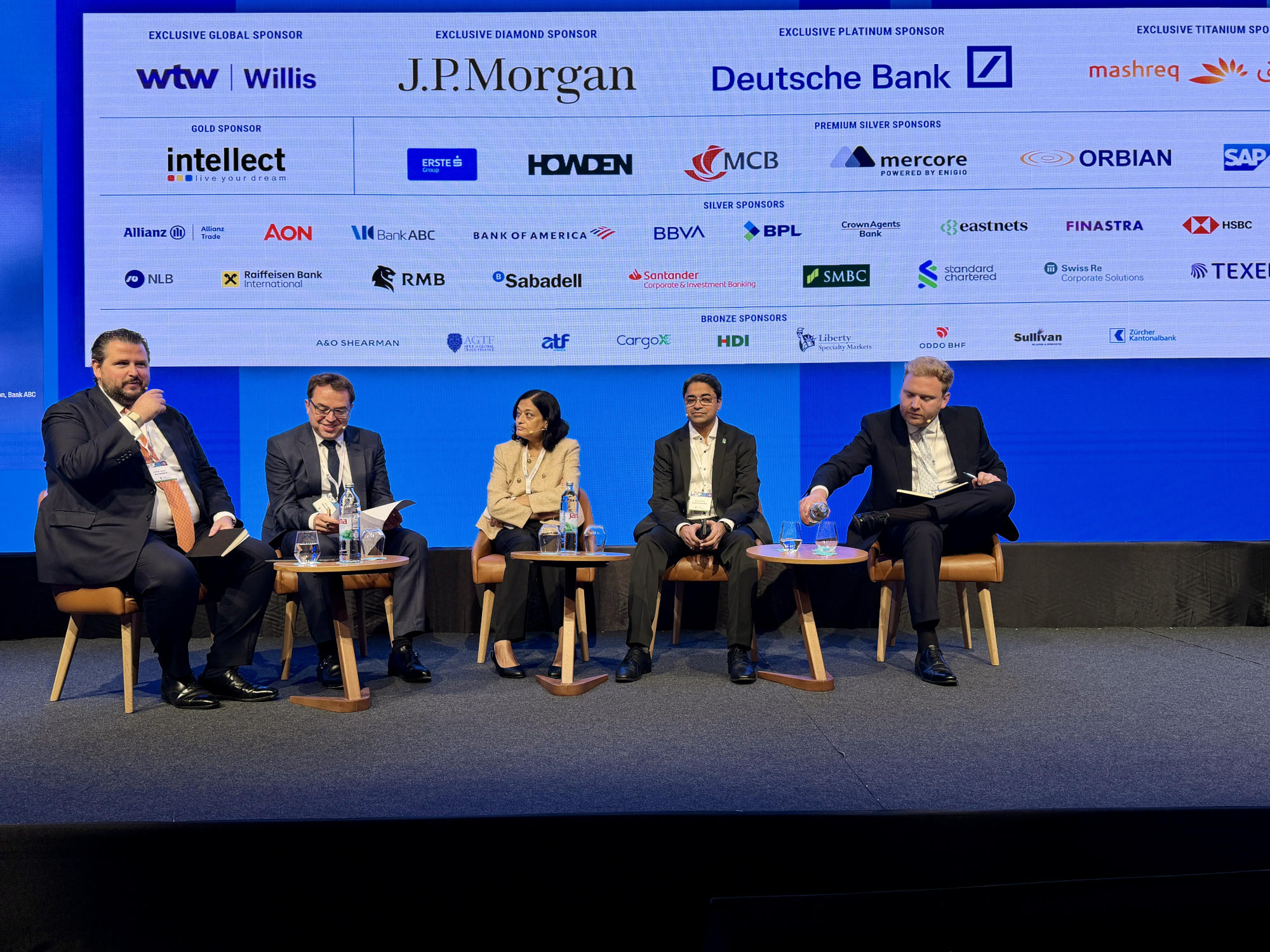
Jonathan Lonsdale (Banco Santander) and Boris Jaquet (Deutsche Bank) Aarti Mohapatra (Mashreq), Vipin Vashishtha (Standard Chartered Bank) and Jack Robinson (Bank ABC) talk investable trade finance assets at ITFA Croatia 2026
Institutional investor appetite
Despite the work being done by the ITFA Trade Finance Investment Ecosystem Working Group3 to facilitate asset risk transfers between banks and non-bank investors, the progress of trade finance assets towards becoming a regular choice for institutional investors has been slow.
The points made at past ITFA conferences regarding investor education and asset structure remain. Back in 2022, Guy Brooks, a Portfolio Manager within the Working Capital Solutions team at Pemberton, noted that while there was scope for more funds to move into the trade finance space, “this requires further education and a more thorough discussion with investors about what trade and working capital finance actually is and the benefits it brings”.
“I still don’t see a sizable participation from institutional investors,” said Santander’s Jonathan Lonsdale in a follow-up discussion four years later at ITFA Split. “While there are some specialist funds, we’ve not yet been able to tap into the really large pockets of institutional cash as an industry.” Jaquet countered that one should not be viewing institutional investors as if they were replacing banks or insurers: “They can in trade, on the asset side, for instance big insurance companies who are looking at trade assets. They may not be able to originate trade assets, but they can buy them and repack them to sell to their own investors.”
As for the trade assets themselves – trade ranges from a three-month letter of credit to a 10+ year project finance deal. “So, if you slice and dice trade finance you have different types of investors. In structured trade finance we see investors coming in directly as lenders,” reflected Jaquet.
Panellists agreed that portfolio solutions such as tranching to make non-investable assets scalable and accessible through “proper wrapping”4 had become a priority to gain traction with institutional investors.
Financing deterrence
“European defence expenditure is not simply a temporary response to what we are seeing in Ukraine. It reflects a genuine structural reassessment of the security environment,” declared General Sir Patrick Sanders, Senior Strategic Adviser at Banco Santander, in the opening keynote address to ITFA 2026 delegates.
At the end of 2026, Deutsche Bank economists flagged Europe’s need to increase defence spending “when deficits are high”, and Sanders clarified how NATO requirements5 drive “enormous investment” across conventional military capability as well as emerging technology – along with the infrastructure supporting both. The financing need “includes ports, rail, energy resilience, data infrastructure, warehousing, telecommunications, critical minerals and secure logistics.”
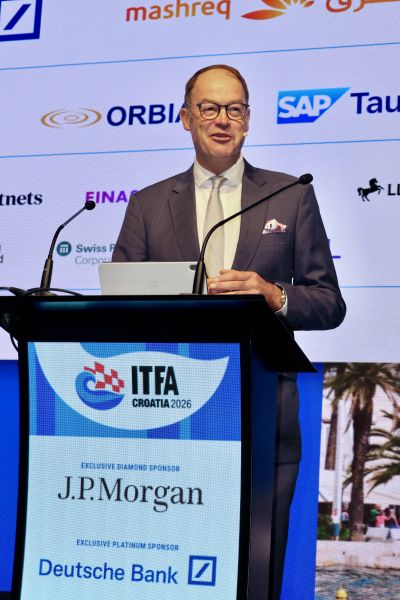
General Sir Patrick Sanders, Senior Strategic Adviser at Banco Santander, explains to ITFA Croatia 2026 delegates how a wide range of financial instruments are essential components of national and collective security and deterrence pillars
Sanders – who led the British Army between 2022–2024 – went on to explain that public finance could not and should not meet the requirement alone, with private capital playing a crucial role, “particularly where the strategic value is high, and where conventional finance encounters obstacles”. In particular, the challenge, he said, is to “connect sovereign demand with capital all the way down the industrial chain, including the SMEs, specialist manufacturers and technology companies on which the larger manufacturers depend.”
So, what does this mean for trade finance deal origination – and distribution? Jaquet explained that some of the larger defence companies are cash rich and “don’t necessarily need financing”. As a result, there are not as many deals being originated as was perhaps originally expected, and the ones that do come to syndication – especially with an ECA component – are usually “significantly oversubscribed”, with “rather competitive pricing”.
Banco Santander’s Lonsdale made the point that a large manufacturer would need components from a mid-sized company or SME that cannot access finance – not only because many of them are underbanked but because the defence sector itself had historically been non-bankable, or that the component required in the defence product might represent a small part of that SMEs overall business. Both Lonsdale and Jaquet agreed that while there were certain limitations on what type of defence financing assets you could originate (e.g. NATO or non-NATO, or infrastructure rather than actual military equipment), there has been “a sea change in the past four to five years”.
Summary of key points
- Balance sheets cannot expand and having the right tools, the right investors and strong distribution partnerships where risk can be distributed quickly are key to balance sheet velocity
- There are huge opportunities – especially in EMs – to focus on the right trade corridors. Panellists agreed it was about corridors rather than markets
- Robust technology and the right platforms speed up syndication processes and support transparency
- Current competitive pricing reflects overall market volatility.
- Defence/deterrent financing is now a mainstream component of trade finance asset risk being distributed, but more needs to be done to get liquidity through to the long tail of the supply chain
The 52nd Annual International Trade and Forfaiting Association Conference took place in Split, Croatia, from 9 to 11 September 2026
Conference images: courtesy of ITFA
Sources
1 Helpfully documented in the Deutsche Bank Research Institute report, The revenge of the supply-side: A new economic regime by Henry Allen (14 September 2026)
2 See Figure 1 in the flow article Distributing trade finance – a vital contribution (October 2025) at flow.db.com
3 See ITFA Trade Finance Investment Ecosystem (ITFIE) at itfa.org
4 For example, the TRAFIN 2023-1: Deutsche Bank closes fifth trade finance securitisation at corporates.db.com
5 See Defence investment and NATO’s 5% commitment at nato.int


You might be interested in

Trade finance and lending, Macro and markets
Market update: the changing role of ECAs Market update: the changing role of ECAs
While export credit agency (ECA) guarantees play a vital part in keeping trade moving, government priorities are now turning to more active deal origination and financing supplies of critical commodities – and defence. flow correspondent Clarissa Dann provides an update on the ECA market

Trade finance and lending, Macro and markets
Commodities 2026: the Hormuz factor Commodities 2026: the Hormuz factor
The commodity finance community gathered at TXF Amsterdam 2026 to examine how recent events in the Middle East have impacted the trading, producing and financing of key commodities. flow’s Clarissa Dann reveals how traders are diversifying their funding sources and strategically utilising their facilities

Trade finance and lending
Distributing trade finance – a vital contribution Distributing trade finance – a vital contribution
Origination of trade lending assets and then distributing them to other financial institutions and investors makes the scaling up of financing trade possible. flow’s Clarissa Dann provides key takeaways from panel discussions at the 51st International Trade & Forfaiting Association in Singapore