
-
flow case studies, Cash management
How adidas and ITA Airways are automating FX workflows
FX automation goes beyond executing trades. Treasurers from adidas and ITA Airways explain how streamlining currency and payment workflows is helping to reduce complexity and improve control over cross-border cash flows
MINUTES min read
While FX trading and payment execution are already highly automated via treasury management systems in combination with trading platforms such as 360T or FXall, the processes preceding them often remain fragmented and manual. The scope for further automation is reflected in Economist Impact’s 2025 report, Freeing trapped cash: currency workarounds, supported by Deutsche Bank, which found that just 31% of surveyed treasurers used intercompany transaction automation to help address trapped cash challenges.1
For lean treasury teams managing extensive international operations, these pressures can be particularly acute. German sportswear group adidas and Italy’s flagship carrier ITA Airways provide two examples of how corporates are responding. With differing business models, both have worked with Deutsche Bank to streamline FX-related workflows and improve operational efficiency in cross-border payments.
Different businesses, shared treasury challenges
Reporting revenues of €24.8bn in 2025,2 adidas sells its products in more than 160 countries. As the sportswear brand mainly sources its products in Asia and pays its suppliers in US dollars, “effective currency management is a key focus of our treasury department”, the company states in its 2025 annual report. Last year, the treasury department managed a net deficit of around US$8.7bn related to business activities. Of this, around US$6.9bn was against the euro.3
Given the size of the company’s hedging activities, an effective strategy and an efficient process are key, as Marc Andre Mohn, its Senior Director, Corporate Treasury, explained: “We are managing FX risk at our headquarters, where we have the exposure forecasting team, the hedging team and the cash management team all sitting in one location.”
While adidas’ challenges stem partly from coordinating centralised treasury operations with local regulatory and documentation requirements, Rome-based ITA Airways faces a different form of complexity: the volume and variety of its cross-currency flows. Generating revenue of €3.2bn in 2025 and operating an international network spanning more than 70 destinations,4 the airline must manage collections and payments across numerous currencies, channels and counterparties.
“For us, automation, standardisation and process efficiency are not just a choice. It is essential to survive”
Ticket sales generate collections through websites, travel agencies, acquirers and payment service providers (PSPs), many in different currencies and formats. Meanwhile, the airline must make payments to airports, maintenance and ground-handling providers, while processing customer refunds and compensation.
Managing these heterogeneous flows falls to a relatively small treasury function, including just two members specifically responsible for cash management. “For us as a lean team, automation, standardisation and process efficiency are not just a choice,” explained Vincenzo Sibio, the airline’s Head of Treasury and Digital Payments. “It’s essential, I would say, to survive.”
adidas: unlocking liquidity in regulated markets
Restrictions on cross-border transfers can leave cash held in local markets, which cannot readily be deployed elsewhere in the business. Economist Impact’s 2025 report found that 82% of respondents identified documentation and regulatory hurdles as obstacles to moving cash out of restricted markets (see Figure 1).5
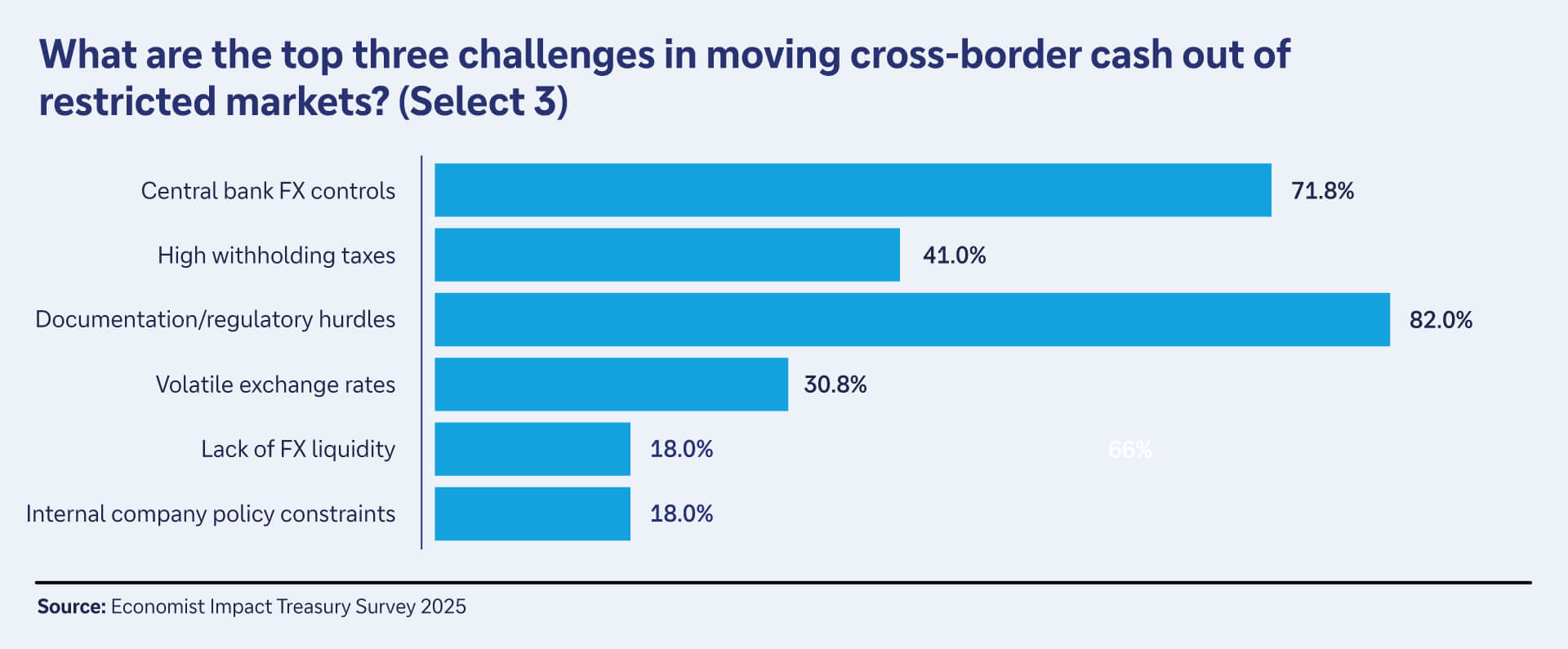
Figure 1: What are the top three challenges in moving cross-border cash out of restricted markets? (Select 3)
Source: Economist Impact Treasury Survey 2025
For adidas, South Korea is a commercially important market. Together with Japan, it generated €1.4bn in net sales in 2025, an increase of 14% on a currency-neutral basis compared with 2024.
The South Korean won (KRW) has historically operated as a restricted or regulated currency with limitations on offshore trading and capital convertibility. For corporates like adidas, this makes currency conversion, intercompany payments and liquidity transfers operationally demanding: as part of currency regulation, firms have to provide evidence of a genuine underlying economic transaction when processing cross-border payments.
“This could be an import/export invoice (alongside an import licence) or an intercompany loan agreement,” explains Harald Abel, Co-Head of Workflow Solutions at Deutsche Bank. If, as is common in the case of large multinational corporations, the invoiced entity in Korea pays directly to the in-house bank, a separate Bank of Korea approval is required before payment initiation. “All this requires close alignment between the paying entities and the cross-border payment bank – simply sending a payment file is not enough.”
As Mohn explained, while FX trading itself is relatively straightforward – adidas uses non-deliverable forwards to hedge its Korean won exposure – the processes surrounding cross-border payments are considerably more complex. “That requires a lot of manual work as you need to involve various teams across the chain, from my team doing the FX transaction to the cash management team then doing the transfer itself, as well as the back-office structure.”
Beyond the operational burden, these restrictions also reduced the flexibility for adidas to transfer potential surplus cash out of South Korea and deploy it elsewhere within the group. “When we implemented the solution in Korea, our aim was to increase process efficiency and enable a more flexible cross-border cash pooling solution,” Mohn explained.
“Cross-border payments require a lot of manual work as you need to involve various teams across the chain”
Together with adidas, Deutsche Bank developed an integrated solution combining automated intercompany payments with cross-border liquidity management under South Korea’s consolidated management funds scheme. The scheme permits eligible companies to access up to US$50m equivalent in South Korean won for a tenor of up to one year, subject to local requirements.
Under the arrangement, payment instructions and supporting intercompany invoice data are transmitted through adidas’ existing host-to-host banking connection. Deutsche Bank’s automation engine uses this information to calculate and execute the necessary FX transactions, while predefined rules enable surplus liquidity in South Korea to be transferred into adidas’ central euro liquidity pool (see Figure 2).
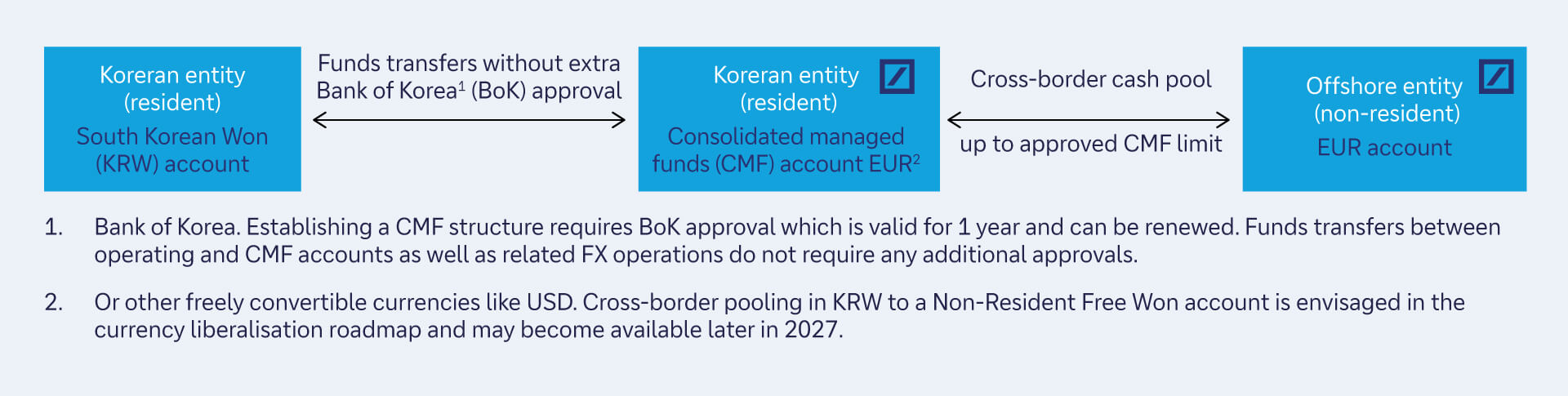
Figure 2: How adidas’ automated cross-border cash pool in Korea now works
Source: Deutsche Bank
The solution was designed to work alongside the company’s existing treasury infrastructure, without requiring extensive changes to its core systems. The implemented solution is not static and can evolve alongside currency liberalisation, Abel adds. In July 2026, the South Korean government released a comprehensive roadmap to transform the won from a restricted local currency into a freely convertible global currency.6
The South Korean project also forms part of adidas’ wider ambition to automate treasury operations wherever possible across its international business. Similar challenges feature in other regulated markets, particularly across Asia and Latin America.
As Abel explained: “Standardisation means giving clients a consistent interface. ERP data delivery should not require a bespoke solution for Korea and a different one for, let’s say, Taiwan.”
ITA Airways: bringing currencies into one treasury structure
Moving from a very heterogeneous FX payment landscape to a more standardised and centralised approach was also ITA Airways’ goal. Previously, the airline required numerous foreign currency accounts and significant manual coordination. Reliance on different payment service providers (PSPs) for FX conversion also introduced higher margins, while limited centralised oversight made reconciliation and cash flow forecasting more challenging.
ITA Airways therefore sought to consolidate its currency flows, improve liquidity visibility and reduce the operational costs of managing its international payments. “Our aim is to have one bank account at headquarters level for all currencies around the world,” explained ITA Airways’ Sibio.
The solution found uses Deutsche Bank’s FX4Cash platform to integrate currency conversion with ITA Airways’ payment and collection processes. Local currency collections received from PSPs are routed through a dedicated UK account, automatically converted into euros and credited to the airline’s central treasury account in Italy. The arrangement also supports cross-currency outgoing payments, bringing a wide range of transactions – from e-ticketing and supplier payments to customer refunds and branch remittances – into a more centralised structure.
Implementation has been phased, beginning with the routing of selected currencies for travel reimbursements through ITA Airways’ euro operational account. As of October 2026, the framework includes 22 currencies, with the largest payment volumes relating to the Norwegian krone, Swiss franc and British pound.
However, introducing the arrangement across different markets has required extensive coordination. “It’s not just a matter of changing standard instructions for routing your collections, because each country has its own peculiarities,” explained Sibio. “It’s a deep dive, country by country, in order to understand all the peculiarities and work with all the different counterparts.”
Offsetting the challenges of implementation, Sibio highlighted three areas where efficiencies can be realised:
- Direct costs. Reducing the costs associated with maintaining bank accounts in different markets, alongside bank fees and FX spreads. The solution also offers greater transparency over FX costs, with potential savings through pre-agreed rates and reduced reliance on PSP conversion services.
- Liquidity visibility. Improving oversight of funds held across international accounts, enabling more effective cash investment and liquidity forecasting.
- Operational costs. Reducing the time treasury teams spend tracking cross-currency flows and determining where funds should be held, used for local payments or converted into other currencies.
From transaction execution to workflow automation
Involving different approaches, the two case studies still share a common principle: the greatest opportunities for FX automation often lie beyond the transaction itself.
“When we talk about automation, at first glance, payments and FX seem automated already,” observed Deutsche Bank’s Abel. “What has changed now is that we start looking at what happens before we see the trade request or before we see the payment file from a client. So, what is the work that clients need to do in order to arrive at the amount they trade?”
For banks, this means looking beyond FX execution and payment processing to address the operational challenges that precede them – from gathering supporting documentation in regulated markets to consolidating currency flows and integrating corporate treasury systems.
It also requires closer collaboration with clients to develop solutions that meet their specific needs. As Mohn explained: “What we appreciated about working together with Deutsche Bank was that we had very solution-oriented communication. We explained exactly what the challenges are on our side, and we found a solution that accurately addresses our problem.”
Sibio similarly highlighted how the bank’s role is evolving. “Banks were considered providers that would receive instructions and do something, or maybe sell a product,” he said. “Major players like Deutsche Bank are now steadily becoming a kind of full-service provider with a high level of IT knowledge that is able to build something that is tailor-made for the company.”
This article draws on comments made during the panel discussion ‘FX automation: the all currencies, all markets challenge’ at the 35th EuroFinance International Treasury Management conference, held in Barcelona from 16–18 September 2026.
Sources
1 See Freeing trapped cash: currency workarounds at economistenterprise.com
2 See Income Statement at adidas-group.com
3 See Annual report 2025 at adidas-group.com
4 See ITA Airways - Strategic Analysis and Outlook Report 2026 (Updated) at aviationoutlook.com
5 See Freeing trapped cash: currency workarounds at economistenterprise.com
6 See Roadmap for KRW Internationalization


You might be interested in
flow case studies, Cash management
Unlocking FX efficiency at Endesa Unlocking FX efficiency at Endesa
The US-dollar is the dominant currency in the global energy market – which is why managing FX risks is a key task for utility companies like Spanish Endesa. flow explores how Endesa’s treasury team has managed to link payment flows with FX trades and drive automation

flow case studies, Cash management
Fewer accounts, faster payments: ABB’s path to a more efficient treasury Fewer accounts, faster payments: ABB’s path to a more efficient treasury
Supporting ABB’s purpose of enabling sustainability and resource efficiency also requires internal functions to operate with greater efficiency. ABB’s Corporate Treasury team, for instance, is using virtual bank accounts to run a leaner and more efficient operation. flow’s Will Monroe finds out more

flow case studies, Cash Management
How Celanese uses virtual accounts to streamline its cash How Celanese uses virtual accounts to streamline its cash
US-based specialty materials and chemicals company Celanese is rebuilding its global liquidity structure. Treasury specialists Hugo Rivera and Peter Szucs tell flow’s Desirée Buchholz why virtual account solutions play a key role in this project – and what lessons they have learned from peers